
Hot Classroom Temperatures Negatively Affects Learning
By Dominic Niyo
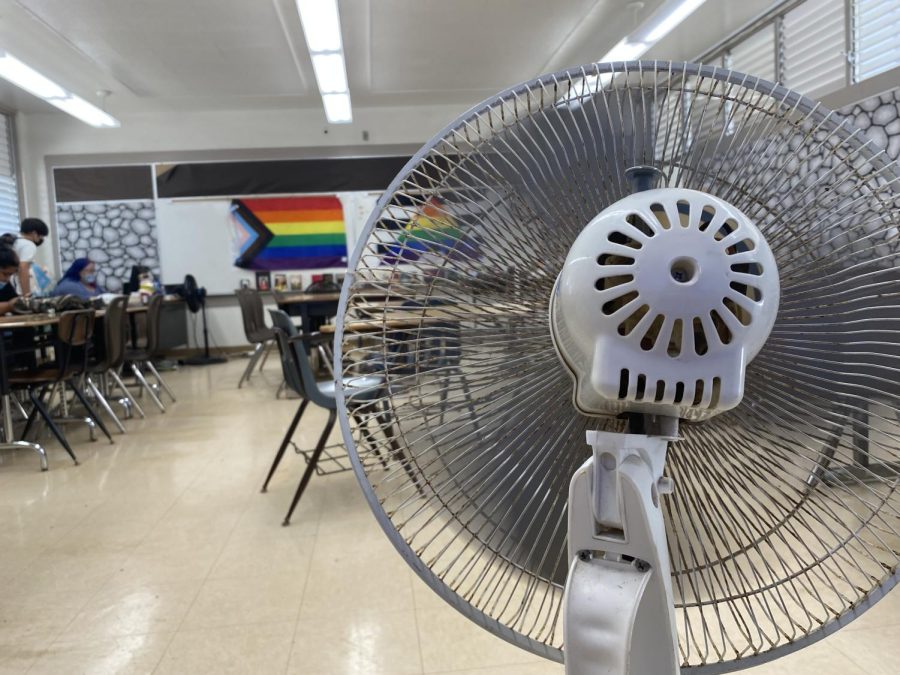
Evon Le’s classroom F154 is one of many without air-conditioning. Instead, it’s cooled with a limited amount of fans for the whole class to share.
October 5, 2022
Since many classrooms in Hawaiʻi have no air conditioning, it becomes difficult to concentrate on schoolwork when the heat is unbearable.
The summer season, which lasts from May to October, brings average daily temperatures of around 85°F, making both the beginning and end of the school year uncomfortably hot. In these conditions, overheated classrooms can leave students feeling exhausted, irritated, and discouraged before lessons even begin.
A 2018 research project by the Harvard Kennedy School of Government examined 21 million test scores from 10 million high school students nationwide and compared them with temperature data. The study found that “without air conditioning, each 1°F increase in a school year’s temperature reduces the amount learned that year by one percent.” This shows that even small increases in heat can significantly affect how much students actually learn.
In more severe conditions, overheated classrooms can also cause physical symptoms such as weariness, nausea, and even heat stroke for both students and teachers.
In 2015, an ʻEwa Elementary School teacher was sent to the emergency room due to heat exhaustion. According to Hawaiʻi News Now, she became dizzy and extremely fatigued, and doctors later said her condition could have progressed to heat stroke. To cope with the heat in her non-air-conditioned classroom, she spent her own money to keep herself and her students cool, yet it still was not enough. Parents later reported that their children looked pale, felt fatigued, and some even began vomiting.
At McKinley High School, we face a similar problem. While no one has been sent to the emergency room, many faculty members, including English teacher Evon Le, have experienced exhaustion due to the heat in non-air-conditioned classrooms.
“I have experienced fatigue in the classroom, especially during the early and later parts of the school year when it gets hotter,” Le said. “I always have to bring a water bottle to keep cool.”
Many students who participate in extracurricular activities, such as sports during lunch, also struggle to cool down before returning to class. Le has noticed the impact this has on students’ energy and focus.
“By the time they get to class, they have very low motivation when the classroom is really hot,” Le said. “Air conditioning would definitely help, and I think it would encourage students to come to class.”
The Department of Education has consistently funded cooling systems, primarily in elementary schools. However, middle and high schools deserve the same priority, especially when the main barrier is a lack of government funding. According to Le, these upgrades are expensive, and schools often cannot afford them on their own.
“When teachers talked to the principal about it, he said there is a lack of funds from the government,” Le said. “If fans break down, I feel like I have to use my own money, and even then it becomes a choice between buying fans or buying school supplies.”
Teachers across the country are already known for spending their own money to support their students. So why is the wealthiest country in the world, in terms of gross domestic product, unable to provide safe and comfortable learning environments for its youth? Adequate educational funding does more than improve comfort—it protects health, supports focus, and creates conditions where students and teachers can succeed. If we want better learning outcomes and higher graduation rates, ensuring classrooms are safe from extreme heat should not be optional.