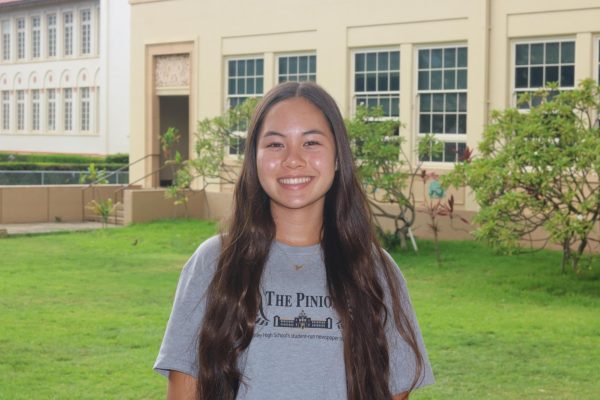

Cheska Orias
Run! Ala Moana Crosswalk Has Pedestrians Counting Down The Seconds – Honolulu Civil Beat
This article is written by Matthew Leonard and talks about the lack of time to get across crosswalks near Ala Moana. Lani Michael is one such resident that lives nearby and raised the concern multiple times to the city council. From things such as older folks not having enough time, cars just going through despite people having the right of way and hit and runs happening.
This article can serve as a mentor text because while being a short read it gets to the point while still being jammed packed with information. When writing articles it is easy to just write and write, putting everything down but trying to condense that information and cut stuff out can be hard. Knowing what information to add and when to include them is important, and Leonard does a great job at including important information. Besides getting information from text the photos and art helps provide more information via allowing the readers to see what the area being talked about looks like.
Rose Ganotisi
Boys’ baseball falls to Arcadia in a blowout loss
This sports article was written by Julia Gildersleeve and published on Tiger News Site. It goes over the boys’ baseball team’s last game against the Arcadia Apaches on May 4th. The Tigers put up a fight but could not match the Apaches’ game and lost.
This article can serve as a mentor text because it demonstrates several qualities of strong sports journalism. One strength is the organization. The writer structures the article chronologically by inning, which helps readers clearly follow the progression of the game from beginning to end. The article also includes detailed descriptions of important moments, such as Matt Rogers’ double play and Arcadia’s home run in the sixth inning, which helps readers visualize the action and keeps the story engaging. Another thing I noted to be impressive is the way the writer supports her school and the baseball team because even though the Tigers lost badly, the writer still highlights their effort and strong defensive plays instead of only focusing on the defeat. However, the article also shows areas where sports writing can improve. Some baseball terminology is inaccurate, such as referring to fly balls as “high balls,” which may make knowledgeable readers question the writer’s understanding of the sport. There are also a few awkward phrases and repeated sentence structures that could be more concise. Overall, the article is a strong example of student journalism because it is detailed, organized, and informative while still leaving room for improvement in technical sports vocabulary and writing style.
Dominic Niyo
This Rich Hawaiʻi Super PAC Is Already Shaping A Key Statewide Election – Honolulu Civil Beat
The article by Kevin Dayton looks at how Pacific Resource Partnership and its super PAC, For A Better Tomorrow, are shaping Hawaiʻi’s lieutenant governor race. It explains how the PAC moved fast to support Derek Kawakami right when Sylvia Luke’s campaign fell apart during an investigation. Dayton also lays out PRP’s long history of spending big in local elections and influencing major races across the state.
This works as a mentor text because the reporting is deep and sourced from people who actually lived the story. Dayton talks to political scientists, former candidates, and PRP leaders, and he backs everything with specific numbers and past examples. The transitions carry the context, and the quotes add clarity without taking over. It shows how good journalism connects current events to a larger pattern, uses real voices, and stays objective while still revealing how power works in local politics.
Laurie He
Anne Battle has Alzheimer’s — And she wants you to know it – Best of SNO
This article written by Matilda Haney Foulds talks about Anne Battles’s experience with Alzheimer’s and her efforts to destigmatize the condition. Despite the condition being uncommon, Anne struggles to find someone who will openly talk about Alzheimer’s. So, she seeks to normalize the condition by wearing an “I have Alzheimer’s” pin gifted by her daughter, Lisa Battle.
This article serves as a mentor text because it goes beyond the lead. It gives readers a glimpse of Anne’s journey, from when she first found out she had both APOE genes, to her feeling angry and depressed about the result and her trying to reclaim agency in her life. In the article, it says many people who know Anne would describe her as “blunt.” And I believe the quote used: “I want to normalize it like cancer. I want people to say, ‘You have Alzheimer’s? I have Alzheimer’s! How is it for you?’ Because it’s not the end of the world,” does a great job at showing readers why they said that. The quotes from Lisa tug at the reader’s heart because it gives readers an idea of what it’s like having a loved one with Alzheimer’s. And the photos, especially the one where Anne is in her music room, makes it feel as if the readers were also there in the room when the photo was taken.
Laurie He
Cafe Momentum Is Serving Up Second Chances
This article, published in The SUNN Post and The Southerner, was written by Dylan Seinberg and Alex Brendle. It talks about Café Momentum, a nonprofit founded in Dallas with restaurant locations across various U.S states, that offers job training, education and other support for teens that were formerly incarcerated.
The article can serve as a mentor text because the reporters interviewed people like Joshua Lee, a chef involved in the restaurant. This interview gave them important insight about what Café Momentum hopes to achieve with their 12-month paid internship program, more information about what their internship entails , and what support they offer after the internship is over. Interviews with the interns and diners also give readers a deeper look into how the restaurant model helps the interns and the community. There is transparency and the reporters show ethical reporting as it is specifically stated in the article that the names of the interviewees have been changed upon their or the organization’s request. Seinberg and Brendle also offers readers valuable insight through the statistics included in the article, specifically in the transition paragraph where it says youth recidivism in Georgia sits at around 36% as of 2024, an issue Café Momentum seeks to address.
Jacky Oasay
Hawai’i Families Need Preschool. Who Will Fund It?
This is an article written by Megan Tagami, the education reporter at Civil Beat. Hawai’i is currently facing a government storm of political leadership changes, legislature failures, and federal budget cuts that threaten universal preschool.
With Lieutenant Governor Sylvia Luke’s leave of absence due to an ongoing state investigation, she spearheaded the “Ready keiki” initiative, a push for preschool in Hawaii for universal access by 2032. The situation is further aggravated by an impending federal “funding cliff,” as expiring grants threaten to shut down rural and Native Hawaiian programs like Tutu and Me, leaving nonprofits struggling to keep their doors open. Overall, the article emphasizes that despite high demand from families facing the nation’s highest childcare costs, the lack of a clear funding strategy and a persistent teacher shortage make the goal of universal preschool increasingly unlikely to be met.
This is a good mentor text because it gives good background information about Sylvia Luke’s leave and its impact on the issue at hand. This would be good to apply to my journalism to effectively input background information. I also like the subheadings and how it makes it easier to read. The photographs are also effective because the captions give good information, along with the photograph itself.
Elle Kakuda
UHM Students Face Proposed 7% Meal Plan Increase
The article is titled “UHM Students Face Proposed 7% Meal Plan Increase”, and it is a news piece which is written by Andrew Smith. This article talks about how the prices have increased and the student’s meals are getting more expensive. Some students are required to get meal passes unless they live in apartment like housing.
This article servers as a mentor text because it gives information about how students are facing the prices of lunches. This meets impact because this is something every college student might struggle with not just UHM students. They interviewed someone that talked about how the lunch prices had crazy inflation. There was also a survey created for students to talk about the impacts of the food inflation costs. The “boots on the ground” was that they had good information about how this can affect people’s situations. The inverted pyramid was used in this article, and there transition paragraphs had a lot of detail. The kicker quote was “We want to hear directly from students and understand how these rates affect their budgets.” since it shows that there trying to understand the students perspective on the situation.
Elle Kakuda
Resilience in the Face of Rising Costs
This article is titled “Resilience in the Face of Rising Costs”, which is a news article written by Dwight Byrum. It talks about how food is rising in costs, and how you can bulk up on groceries so that you can spend less for more quantity of food. A food company Gofarm recently partnered with the nation of Hawaiʻi in Waimānalo, which trained newer farmers to be able to have land and food.
This article serves as a mentor text because it has good information on how the food costs have rapidly increased in the past few years. Talking also about how farming is a good way to try and help with the situation. This has an impact on readers because this is something that affects us all in a way. This has some timeliness because inflation is always going up. The interviews were good because it showed people voicing how prices have been increasing a lot over the years. The “boots on the ground” was that they talked about how ICE was acknowledged and the effect it had on food production. There transition paragraphs had a lot of detail about how food in general has been affected by the price inflations. I think that “Larger producing operations feed a lot of people, and those are the ones getting hit.” is a good quicker quote because huge manufacturing companies are the ones being affect the most right now.
Dominic Niyo
Hawai’i Republicans: We Need The ‘Trump People’ To Turn Out The Vote
This article written by Chad Blair and published by Honolulu Civil Beat, examines how the Hawaii Republican Party is navigating its identity and voter turnout strategy ahead of future elections. The article focuses on the party’s attempt to build on recent legislative gains while grappling with whether mobilizing Trump-aligned voters is necessary, or risky, in a heavily Democratic state. Blair situates the issue within Hawaii’s broader political landscape, showing how turnout, not just party messaging, remains the GOP’s biggest obstacle.
This article works well as a mentor text because it shows how objective political reporting can present conflict clearly without inserting opinion. Blair highlights timeliness, impact, and conflict by focusing on an active election cycle and internal divisions within the Hawaiʻi Republican Party. He interviews party leaders and candidates who are directly involved in turnout strategy, which shows intentional sourcing and solid reporting. The article follows an inverted-pyramid structure, using transition paragraphs to provide political context and explain why the quotes matter, rather than relying on quotes alone. The piece ends without forcing a resolution, reinforcing the ongoing uncertainty around voter turnout and party identity.