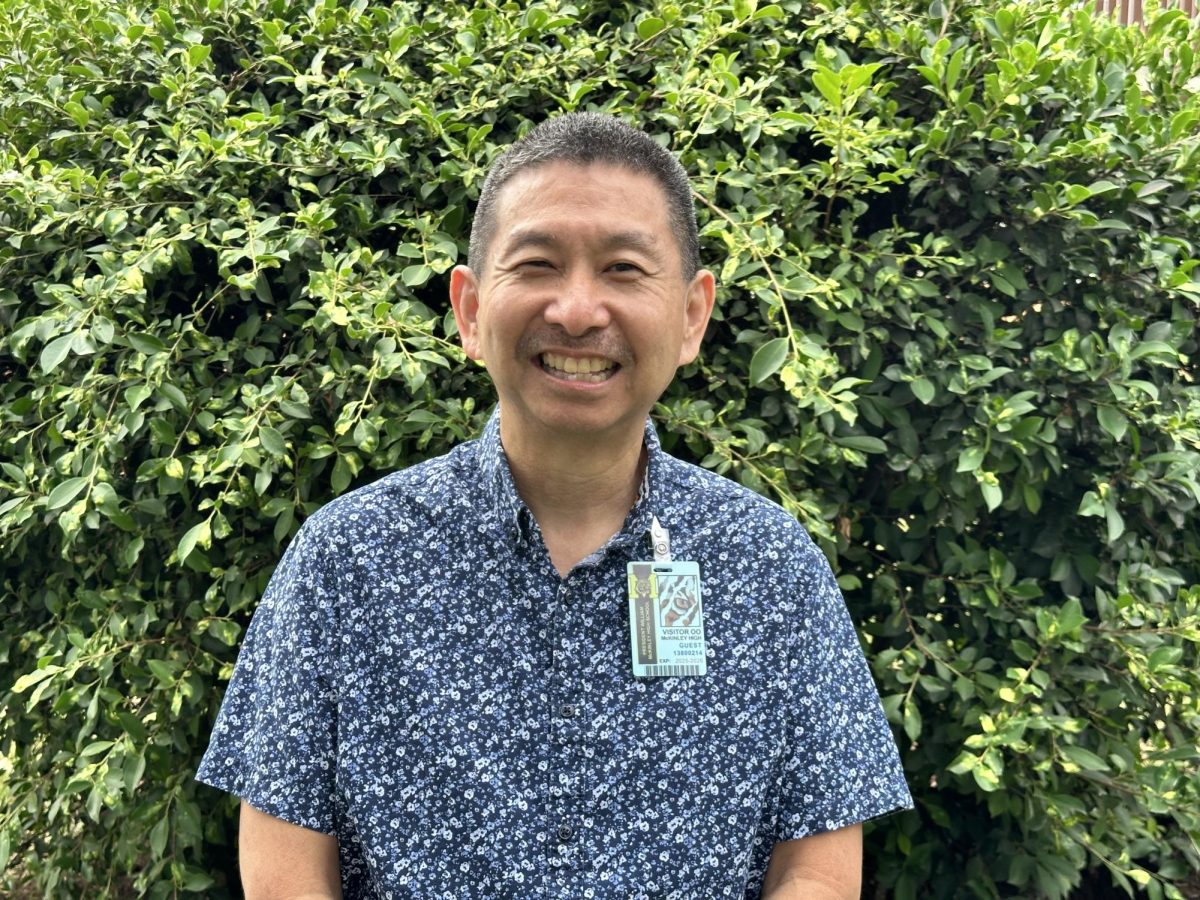
Near the parking lot of McKinley High School lies a brick building and doors to the various classrooms. Behind a double door with the label “Shop 5,” is Milton Lau’s (c/o ‘84) classroom, where he has been teaching electronics for the past 33 years. Prior to returning to the alma mater and teaching Foundations of Electronics, Lau worked for a defense contractor during the Cold War.
Lau’s interest in the defense industry came from Tony Stark, a fictional character who creates an armored suit to escape from being forced to build weapons after being kidnapped, from the marvel comic and later film, Iron Man. Having grown up with Iron Man, Lau said he wanted to be Tony Stark.
His dream came true when he started working for Hughes Aircraft Company, a major defense contractor (company that supplies products and services to a military and government) founded by billionaire Howard Hughes in California. Inside a secured, bubble-like lab that would even block out radio frequencies, Lau said he primarily worked on components on several fighter and bomber aircraft radar systems.
“I worked on the development of electronic assemblies [process of connecting electronic components onto a circuit board to create a device] for the F-14D Super Tomcat. The plane Tom Cruise flew in the movie Top Gun. I worked on the radar system to track enemy planes,” Lau said.
Lau said all he could think about was working for a big defense contractor, but when he got there, it was not as glamorous as he thought it would be. Lau said he worked there for three years where they paid him and for him to go to engineering school, though he never finished it. Lau asked his boss if he could work part-time and go back to school to major in something else, which they agreed, but Lau decided it would be cheaper to come home.
“I met a lot of nice, smart, interesting people from all over the world. It’s just that one day I told myself, we’re just building things to kill people, and I’ll never see it in action, and someone’s gonna die if I see what we’re working on, put into use,” Lau said.
Lau took a major pay cut and came back to Hawai’i and enrolled at Honolulu Community College (c/o ‘92) for an associates in carpentry. Then Lau enrolled in University of Hawai’i at Manoa’s College of Education where he obtained a BEd (Bachelor of Education) in Secondary Trades and Industry (c/o ‘93) and a MEd (Master of Education) in Curriculum and Instructions (c/o ‘96).
When Lau first left, he said he felt sad because he left all his friends in Los Angeles. Lau hoped he made the right decision by becoming a teacher as he took a major pay cut; it took him 10 years to make what he was paid during his time in Los Angeles. Lau said he was also a little older, about 22 years old when he went back to school, which he felt might have been a little late. Lau said the biggest challenge coming back was the withdrawals; he was asking himself, “Why did I leave?” So, he decided to slowly make the adjustment and refocus his mind on going back to school rather than making money.
Luckily for Lau he said, Patricia Hamamoto, the school principal at MHS at the time, and Mary-Ann Kadooka, a physics instructor also at MHS at the time, offered him a position at the school before he graduated from UHM. And he has been teaching electronics ever since.
“ I was very lucky to come back here … This place has been very special to me. Not only that I graduated from here, my whole family came here … Even the neighborhood I lived in, everybody came,” Lau said.
Lau said he had to do a lot of work to the shop as the previous teacher, who mainly taught TV repair and vacuum tube technology, left huge, black and white TVs that were like big metal boxes. They had no color and Lau thought it was kind of depressing so he threw them all away in order to start fresh. Lau said he did keep things like the broken windows and benches inside the shop.
“Every week … I have one or two alumni come here and these guys graduated in the 50s, 60s, 70s, and 80s. When they walk in here, they remember … where they sat, what they did …. There’s something special about something historic, sentimental, [and] significant. That’s why I didn’t throw out a lot of things,” Lau said.
Nowadays, Lau said he teaches students how electronic components work, how to fabricate circuits, and how to use different types of tools. What students are learning in math and science is applied in electronics class through hands-on applications. Lau said learning how to work with people of all different walks of life, different personalities, and learning how to communicate with them was the best skill he acquired from his previous career path that has helped his teaching. He hopes the memories he created, and hopefully, the good that he shared with the students will be worthwhile for them.
“It was worthwhile for me,” Lau said. “It’s a big honor to be teaching here. And I have no regrets … I may not be rich or anything but … there’s more to life than money. I live within my means … I have my own house … I can support my kids, my family. I don’t need anything more than that. I go to work happy, I go home happy.”
Lau’s past career lives on through his teachings too. One of Lau’s students, Sean Willem Giron, said that Lau shared the story of how he used to build weapons with them to teach them any job is worth going to as long as you enjoy it along with getting to know him better.
“No matter how less pay it is, or how dead end it might be. As long as you’re enjoying your job, it’s the job for you,” Giron said.
The story intrigued Giron, who refers to himself as a nerd. Giron thought it was cool Lau built weapons but once he heard the full story, he realized why Lau had left.
“It made me realize … just how brutal that type of job is and made me realize how good other jobs are, like teaching,” said Giron.