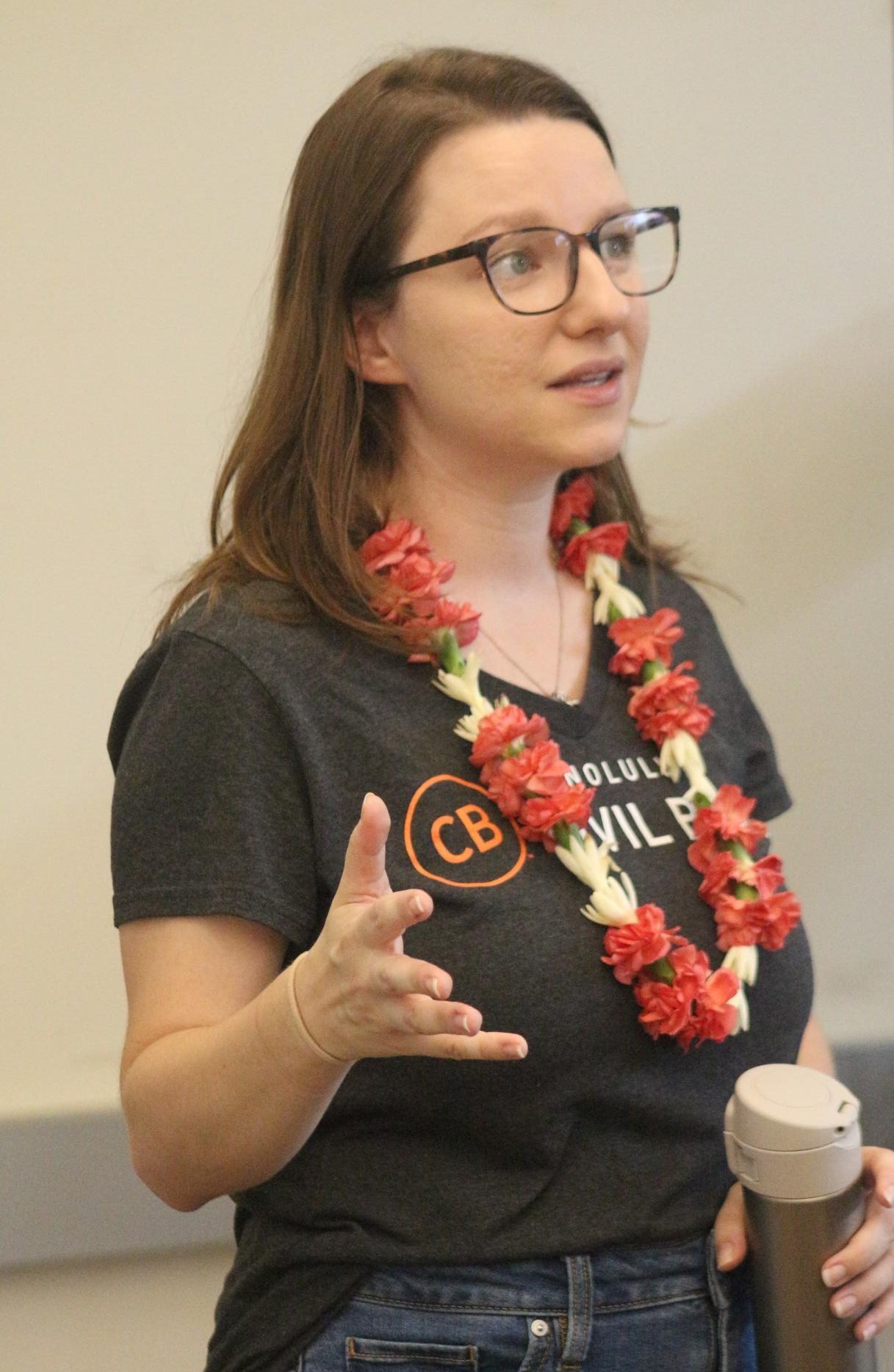
On Tuesday Oct. 21, during Period 4, Ms. Dhakhwa’s Period 4 and 6 classes joined Ms. Reves’ Period 4 Newswriting students to meet with Christina Jedra, an investigative journalist working for Civil Beat. Jedra started by explaining her background in investigative journalism, then led the rest of her presentation as a Q and A.
In Jedra’s definition, investigative journalism exposes fraud or something in the public interest that takes digging up to find. From Jedra’s experience, it is most challenging to uncover powerful people. She said she thinks her most impactful story was the one about the Red Hill water crisis because she wrote continuous stories until Redhill was shut down. While she knows it was not solely her work that caused the shutdown, she is proud that she brought publicity to the topic.
Faailangi Fauolo (℅ ‘28) said she felt it was an informal presentation but Jedra shared a lot of good advice and tips. One of Jedra’s tips that stood out to her was the phrase Jedra repeated multiple times, ‘Fake it to you make it.”
Fauolo said, “It’s not really about pretending, or ‘faking,’ but ‘making,’ believing in yourself and having the confidence of the person you are.”
Dhakhwa organized Jedra’s visit to McKinley through an Instagram DM, she said in an interview after the presentation.
“Actually, at first it was a comment on one of her posts…and then we went from there,” Dhakhwa said.
She added Jedra was easy to communicate with and said, “She was more than willing to show up to come talk to us.”
Dhakhwa said she hopes Jedra’s presentation was a good experience to expose students to journalism and what a journalist in today’s world has to deal with.
“Based on your guys’ takeaways that Ms. Reves took on that digital poll, you guys were able to take away some valuable lessons,” she said.
Jedra’s perseverance and her tenacity is something that stood out to Dhakhwa.
“She’s not scared [and] I hope that you folks can see what the First Amendment in action is,” she said.
Dhakhwa explained the First Amendment goes over Freedom of Speech and Press which is important for journalists and everyone in general, especially in today’s age.
“I hope to continue to work with these local organizations that are helping to build a better society,” she said.
Dominic Niyo (℅ ‘26) is a student journalist and reporter for The Pinion who was at Jedra’s presentation. He said investigative journalism is something he has always loved and in fact, although there wasn’t enough information at the time on it, his first story he wanted to write in his freshman year was about Dawn Momohara’s murder at McKinley in 1977.
“I think it was a really amazing opportunity to speak with a professional journalist,” he said.
A main takeaway he got out of her presentation was when she mentioned letting the silence speak for itself.
“I think that was a really powerful moment because journalists want to ask questions right away,” Niyo said.
Jedra explained when people are struggling to answer questions, you have to ensure not to overload them with a lot of questions, but instead ask one question and let the silence draw out the truth.
Although he does not know Jedra that well, from the experience with her in person, Niyo said, “I think she’s a really great model for journalists overall especially since she is a graduate of Emerson College…and considering her experiences with stepping out of her comfort zone. I could relate myself to her and that’s something I appreciated.”