The Nesian Roots Club at McKinley High School, formerly known as the Micronesian Club, was renamed this year to unify students from various Pacific Island backgrounds into one organization. The name change took place at the end of the 2024–25 school year when Mohealani Feiloaki (c/o ‘26) stepped into the role of president. With the transition, she led the decision to change the name of the club from Micronesian Club to Nesian Roots Club.
When reflecting on the change, Feiloaki said, “I feel like it’s going to welcome more people because it’s not just Micronesian. It’s also Polynesian and Melanesian now.”
The club is advised by Dusty Santos, who has taught at McKinley since 2010, alongside co-adviser Lorheba Josiah, who joined the school in 2022. According to Santos, the name change also helped solve challenges caused by separate smaller clubs, such as Polynesian and Melanesian groups, which often struggled with limited adviser support. He said bringing them together under one organization created a more unified space for students to support one another academically and socially. Josiah said the change has also led to a noticeable increase in membership. She said the club has more Samoans and Tongans this year than ever before.
Both advisers said they stepped into the role because of their commitment to supporting students.
“When I first started working [at McKinley] I saw that there were lots of Micronesian students here, and nobody really likes to work with them, that’s where I stepped up to formalize the club,” Santos said.
Santos, who is Micronesian and from Pohnpei, said he can relate to many of the students’ experiences.
“I might be one of the only people that they can talk to because I can understand where they’re coming from, what they’re struggling with, and what their home life is like,” he said. “Also, I’m the one that communicates with their parents.”
He added that the club focuses on helping students succeed academically, build social skills and serve the school community. The club participates in on-campus activities such as campus beautification projects, including cleaning and repainting sidewalks, as well as off-campus events like attending the Micronesian Festival, Youth Summit and Women’s Day Celebration.
“All the moments that we go out to do activities, either on campus or off campus, I feel proud of [the students in this club] because as the adviser, I expose them to things that I don’t know who else will show them,” Santos said.
Josiah previously served as an adviser for the Micronesian Club at Palolo Elementary, where she worked alongside a partner to support and teach the Micronesian community. When she moved to McKinley, she said she was looking for a less demanding role but still wanted to contribute to the community, so she chose to serve as assistant adviser for the Nesian Roots Club.
Josiah said what she believes makes the club special is its ability to give students a sense of identity and belonging on campus.
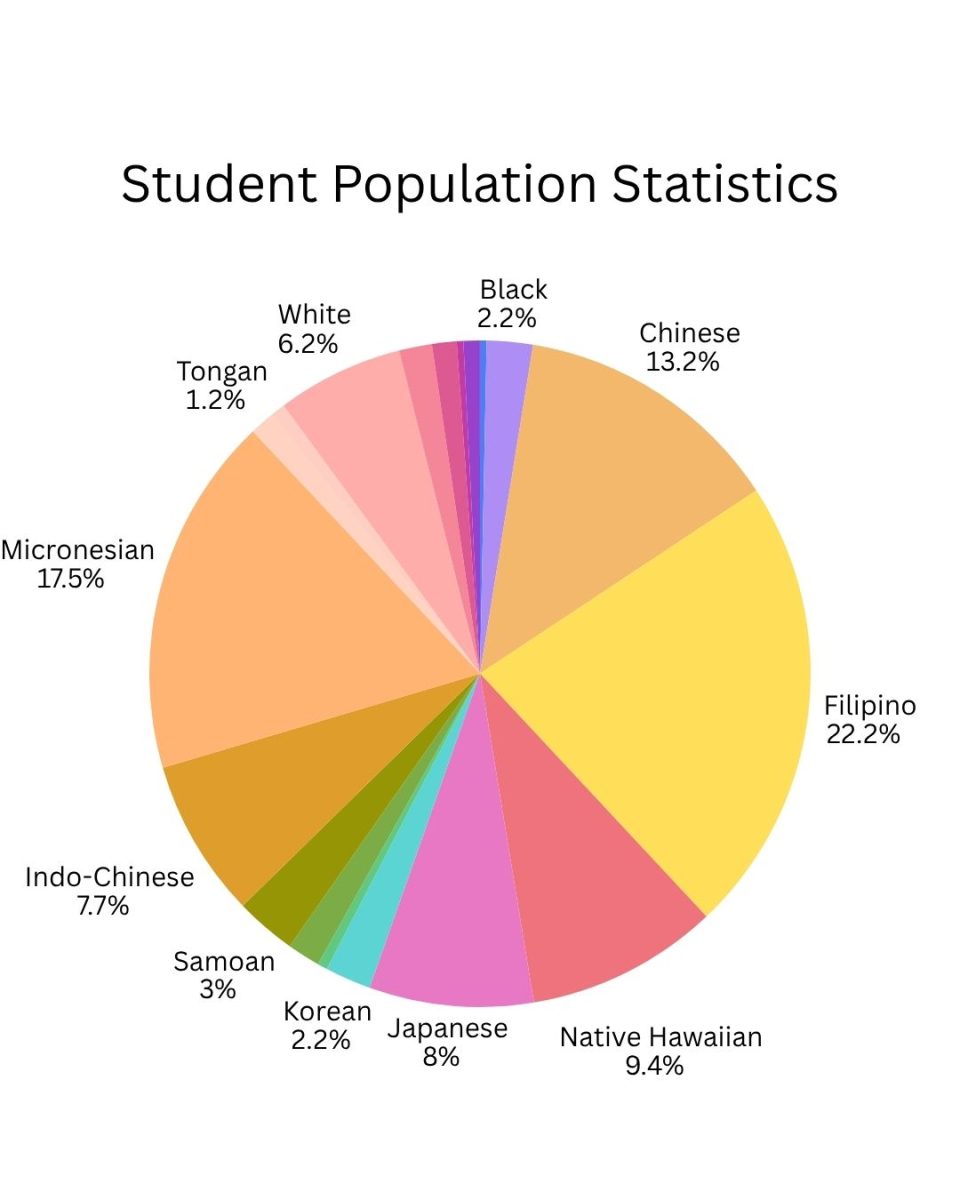
A student population study from last year shows that McKinley’s Micronesian population is the second largest ethnic group after Filipino students, accounting for 17% of the total student population. According to The Clay Center for Young Healthy Minds, identity plays a key role in human development by providing a sense of self, purpose and direction while shaping how individuals connect with their communities.
Feiloaki, club president, said the new name reflects cultural pride across multiple Islander groups.
“The name Nesian Roots represents my pride in my own culture, because I’m Tongan, and I know that a lot of other Polynesians and Micronesians take pride in who they are,” she said.
Feiloaki said she feels the club allows her to connect with her roots because it connects her with people who are a part of the same ethnic group. Feiloaki described her connection with other club members to be deeper than friendship.
“Even though we’re not related, the way I talk to them and the way we create bonds, it feels like family,” she said.
This article has gone through the following process: pitch, interviews, drafting, peer feedback focused on content/structure, revision, peer feedback focused on language/conventions/style, self-checked for ethics and fact-checked by sources. Student editors approve the article for publication.