According to reports, March back-to-back kona lows caused the worst flooding O’ahu has experienced in 20 years. Heavy winds and rain damaged the homes and communities of the people of Hawai’i, which led the Hawai’i Department of Education to shut down all schools twice.
Residents across O’ahu experienced different degrees of changes and impact.
Ezequiel Pina (c/o ‘29) said, “It affected me, because water was coming into the house, even though I live on the second floor, and the power went out, [it] just kept going on and on.”
Pina said while everything was happening, he called family and friends to make sure everyone was okay. In addition to this, he charged his devices in case the power went out for a long period of time.
Pina said it was tough learning about the storm because he has family in Kaneohe and Ewa Beach, areas that were hit harder than Kapahulu, where he lives.
According to the National Weather Service, flash flooding occurred across the island with the most impact being in the Windward and North Shore areas.
Dominic Niyo (c/o ‘26), a Pinion staffer, said that although he first heard about the storm a week in advance on Instagram, he did not think it would be serious. Hawai’i experiences frequent rain and storm alerts, which some people such as Niyo did not take seriously because of how frequent the reports are.
“They have storm [warnings] almost daily and it’s just regular light rain,” he said. “For this storm it was the first time in four years, [my] first time in high school, where they actually had to close schools.”
The storm also interrupted spring break, which was meant for students and teachers to rest. Instead of doing so, many had to endure the storm and worry about their homes, rather than getting a mental refresh for the new quarter.
David Scarlino, who teaches juniors, said, “I’m pretty exhausted.. maybe [I’m] just coming out of being so overwhelmed from it.”
During the duration of the storm, Scarlino spent his spring break wiping down walls and floors. He added at one point, the power was out for over a day.
“Spring break was just, no break. It really wasn’t a break,” he said.
After the storm ended, people faced serious repercussions. Even for those whose homes were not completely destroyed, damage was still critical.
Shunya Ku’ulei Arakaki, a social studies teacher for special e
ducation students and workplace readiness, said, “On Friday the 13th, I was actually just at home doing nothing. There’s nothing we could do. It was during that night, my roof above my bathroom came crashing down.”
Arakaki said her reinforcements is a tarp in the shape of a V that covers the hole in her ceiling and directs the water that comes in into a bucket below it.
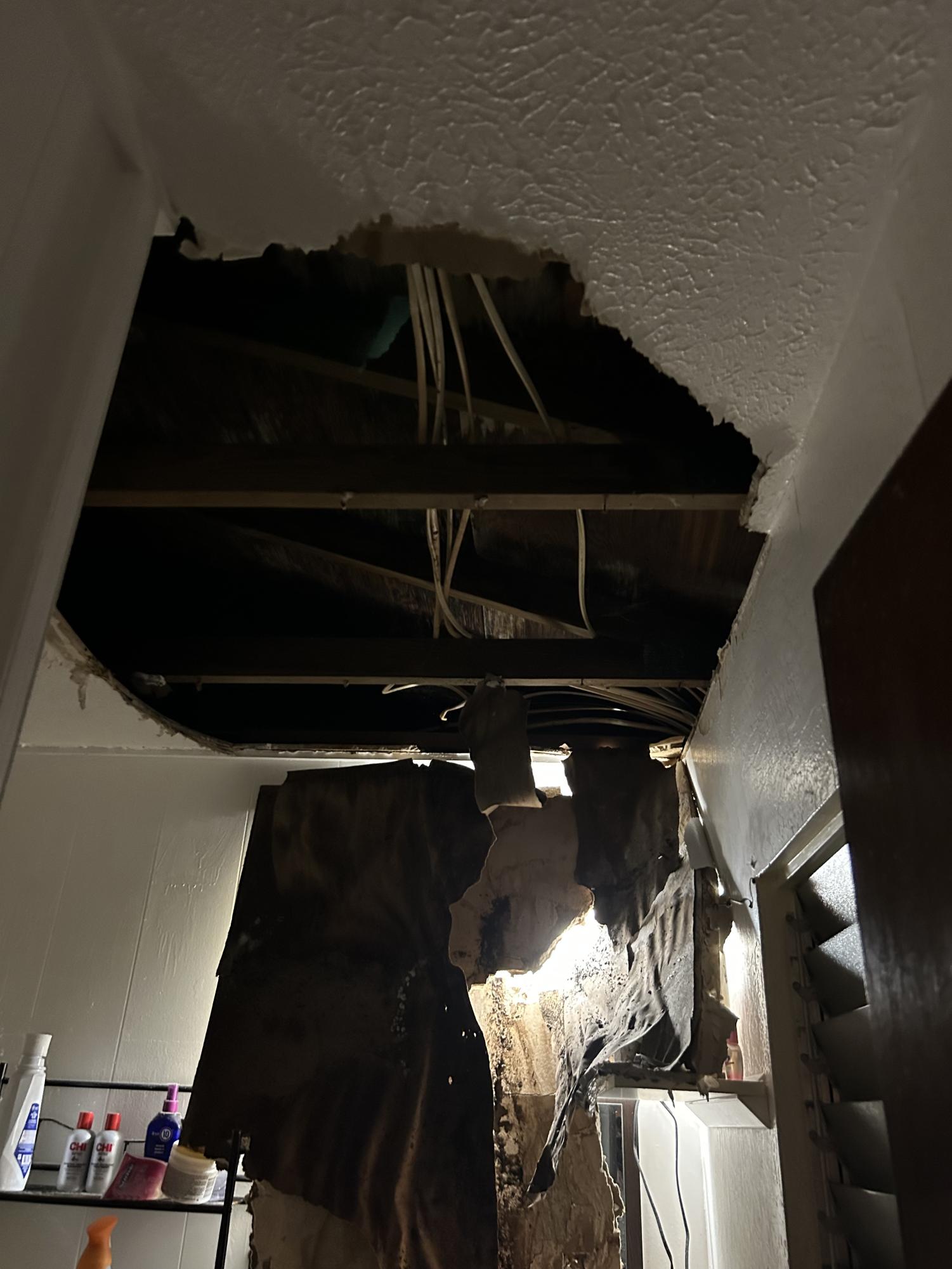
Photo by: Shunya Ku’ulei Arakaki
Her electricity bill is twice as much as it normally is because her solar panels were destroyed. Arakaki said she regrets not having someone come in to periodically check her roof. She said she wouldn’t be in the predicament she is now if she had done so.
As residents began recovering from the effects of the storm, the community came together to support one another.
“We had a community meeting, and we’re all trying to figure out how to secure our homes,” said Arakaki.
Arakaki and her neighbors have put in new foundation walls to support the floors of their home that was washed out because of the heavy rain.
Though the storm was underestimated and affected many in unimaginable ways, families and communities are still building each other up.
“Don’t matter how big the problem is or the disaster, just have you and your community stick together and we’ll pull through this,” Pina said.
This article has gone through the following process: pitch, interviews, drafting, peer feedback focused on content/structure, revision, peer feedback focused on language/conventions/style, self-checked for ethics and fact-checked by sources. Student editors approve the article for publication.