In 2020, McKinley alumnus Shane Kaneshiro (c/o ’24) was a freshman on The Pinion staff. During his first work party, his adviser Cindy Reves gave him a five to six inch stack of old papers someone had donated to her classroom and said, “Why don’t you read this?” He honed in on the editions from the 1970s, sparking his interest for McKinley and Hawai’i’s deep history through the papers.
“I was reading this, and it was so interesting,” Kaneshiro said. “You see how students interact with each other, what the newspaper wrote back then, the different shenanigans.”
This interested started in his freshman year has led him to starting a project, with the aim of preserving Hawai’i and McKinley High School’s history. In early 2025, Kaneshiro (c/o ’24) began gathering editions of The Pinion from the 1930s to 1940s held in the school library to launch a digitization project aimed at preserving McKinley High School and Hawaiʻi’s history.
Founded in 1920, The Pinion is McKinley High School’s student-led publication and has documented more than a century of student life. McKinley itself was established in 1865, making it the oldest public high school in Hawaiʻi. The newspaper’s 100-year milestone was celebrated by the current staff in October 2025.
“When people try to understand what happened in the past, newspapers are one of the first places they go,” said Reves, the current adviser of The Pinion and an 11th grade English Language Arts teacher. “Old newspapers are time capsules. It’s not just what was written, but what’s around them. That’s what young people cared about.”
Kaneshiro’s digitization project prioritizes the years 1934–1946, which capture student life before, during and after World War II. During this time, The Pinion continued printing and distributing newspapers despite the challenges of the war years.
“You have a high school newspaper that recorded students’ thoughts, activities and daily lives,” Kaneshiro said. He added that the publication also documented other schools in the district, such as Saint Louis and Kaimukī High School. “We have the history of how everything became. Preserving this preserves not just our school, but everything else.”
Kaneshiro was involved in The Pinion and JROTC during high school and currently works as an archivist and event assistant at Pacific Historic Parks, where he helps preserve historical materials and photograph educational events. Digitizing The Pinion is part of his job and is supervised by his manager. Along with his passion for history, he noticed the deterioration of the pages.
“The pages were eaten by termites and kept in tight spaces,” Kaneshiro said. “The paper is not meant to last forever. Having a digital that’s actually high quality will be beneficial for everybody because it tells the history of Hawaiʻi.”
The interest in protecting The Pinions from the ravishes of time is not new. In the 1970s, former Pinion journalist Bart Asato wrote an article about the first 10 to 15 years of The Pinion, which had been moved from McKinley’s library to the Hawaiʻi State Archives. Images of those editions, as well as all of the issues through 2007, were also compiled into a long PDF and stored on a CD.

Photo provided by Shane Kaneshiro.

Reves said she copied the CD files into her Department of Education Google Drive and an online PDF hosting site called ISSUU as a summer project in 2021. However, these current files are not searchable. The technology Kaneshiro is experimenting with will create searchable PDFs.
The Google Drive folder is connected to Reves’ school Gmail and once she retires, it will no longer be accessible. ISSUU is currently free through the school’s membership with the National Scholastic Press Association, meaning access may be restricted for those without a membership. The CD remains available, but it could easily be damaged, misplaced or lose the ability to view the CDs due to modern day computers not having a CD viewing system.
Reves said she has been searching for a clearer, searchable and more accessible digitization method for nearly a decade, emphasizing the importance of preserving both history and student journalism.
“If there is someone with experience in digitizing physical archives, reach out to us,” Reves said. “Alumni are really proud of The Pinion, and if they want to help preserve it for the future as technology changes, we’d love to hear from them.”
Beyond the historical value, there are practical concerns surrounding storage and preservation.
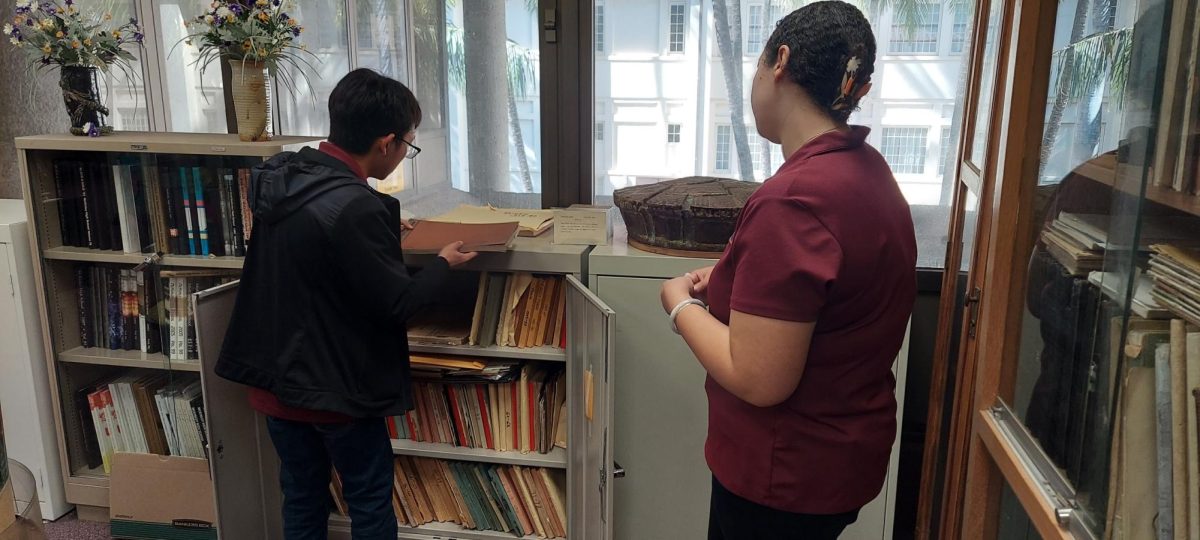
Sandy Domion, the school’s librarian, said extra copies of The Pinion are currently stored in steel metal cabinets, which are not ideal archival conditions.
Domion said archival-quality storage would cost more money and take up additional space. While the library has no intention of discarding the physical copies, she said a searchable and clearer digital version would still be beneficial.
“I think it’s a great benefit for everyone, and it doesn’t take up as much physical space,” Domion said. She added that researchers and alumni would not need to travel back to Hawaiʻi if past editions were accessible online.
Domion said Kaneshiro and his manager collected The Pinion editions from the library over a year ago, but they have not yet been returned.
While progress has been made, the project has faced delays. Reves said her biggest concern is the slow pace, which has been affected by decisions about how the newspapers will be digitized, including whether the editions will be unbound and re-bound and where they will be stored afterward.
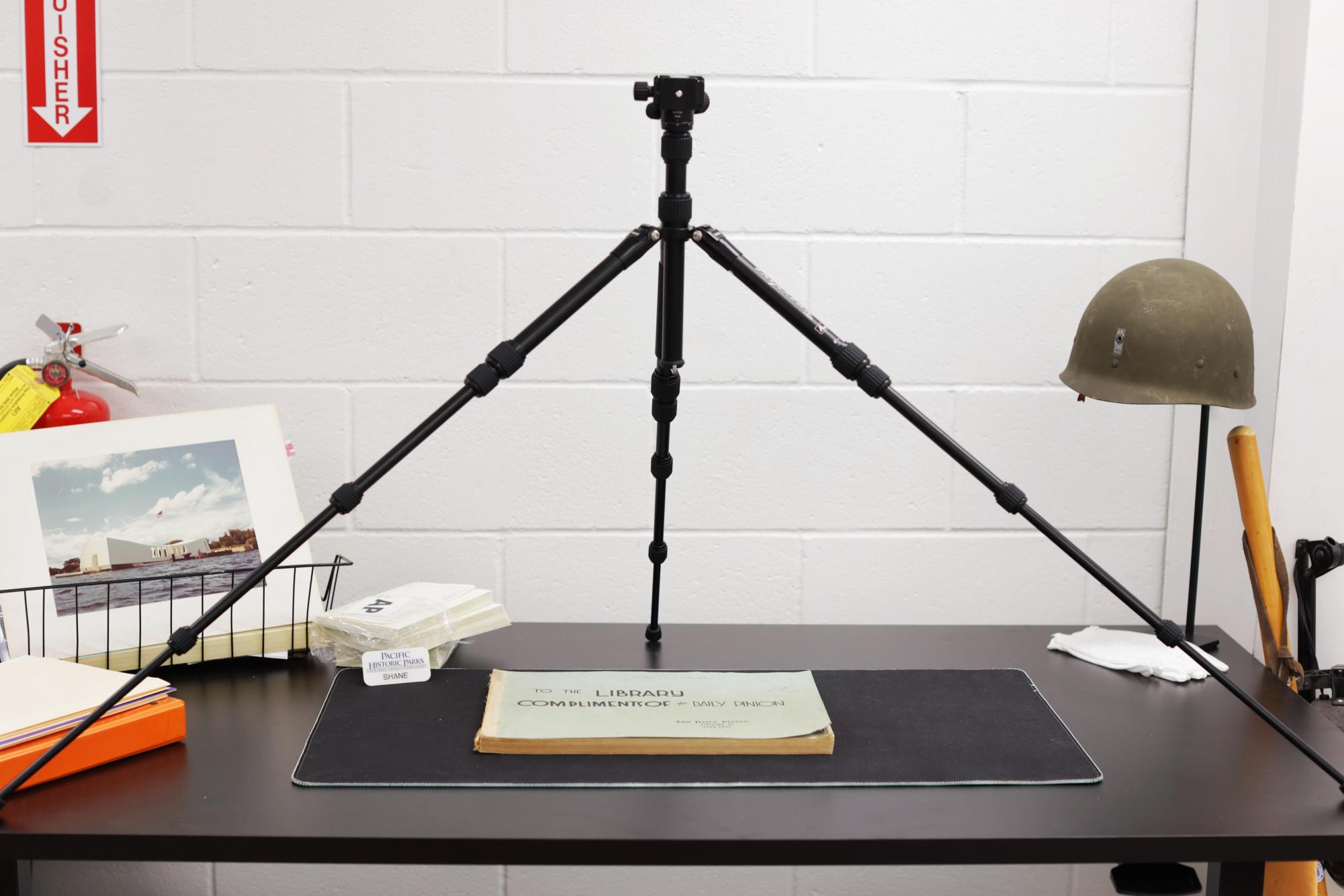
One of the main challenges is that many editions are bound together. Although they do not have to be, it is better for the pages to be unbound and laid flat to ensure high-quality scans. When pages remain bound, the crease from the binding interferes with image clarity and capturing the full scan of the pages.
Kaneshiro said preserving the original editions remains a top priority, which requires careful planning. He also said he is unsure which database will ultimately host the digitized archives.
So far, Kaneshiro has completed digitizing the years 1941–1942, which were not bound. In total, 11 years still need to be digitized by Kaneshiro. With The Pinion’s long history, he chose to focus on the wartime years because of their significance to both McKinley and Hawaiʻi.
Currently, Kaneshiro is handling the project largely on his own alongside his manager. Several questions remain, including where the physical editions will be stored after digitization and how they will be protected throughout the process.
From World War II to the COVID-19 pandemic, The Pinion has documented McKinley’s response to major historical moments, making it a valuable resource for students, alumni and researchers.
“To digitize The Pinion is to preserve Hawaiʻi’s history,” Kaneshiro said. “It’s a daily record of what McKinley students thought, did and lived through.”