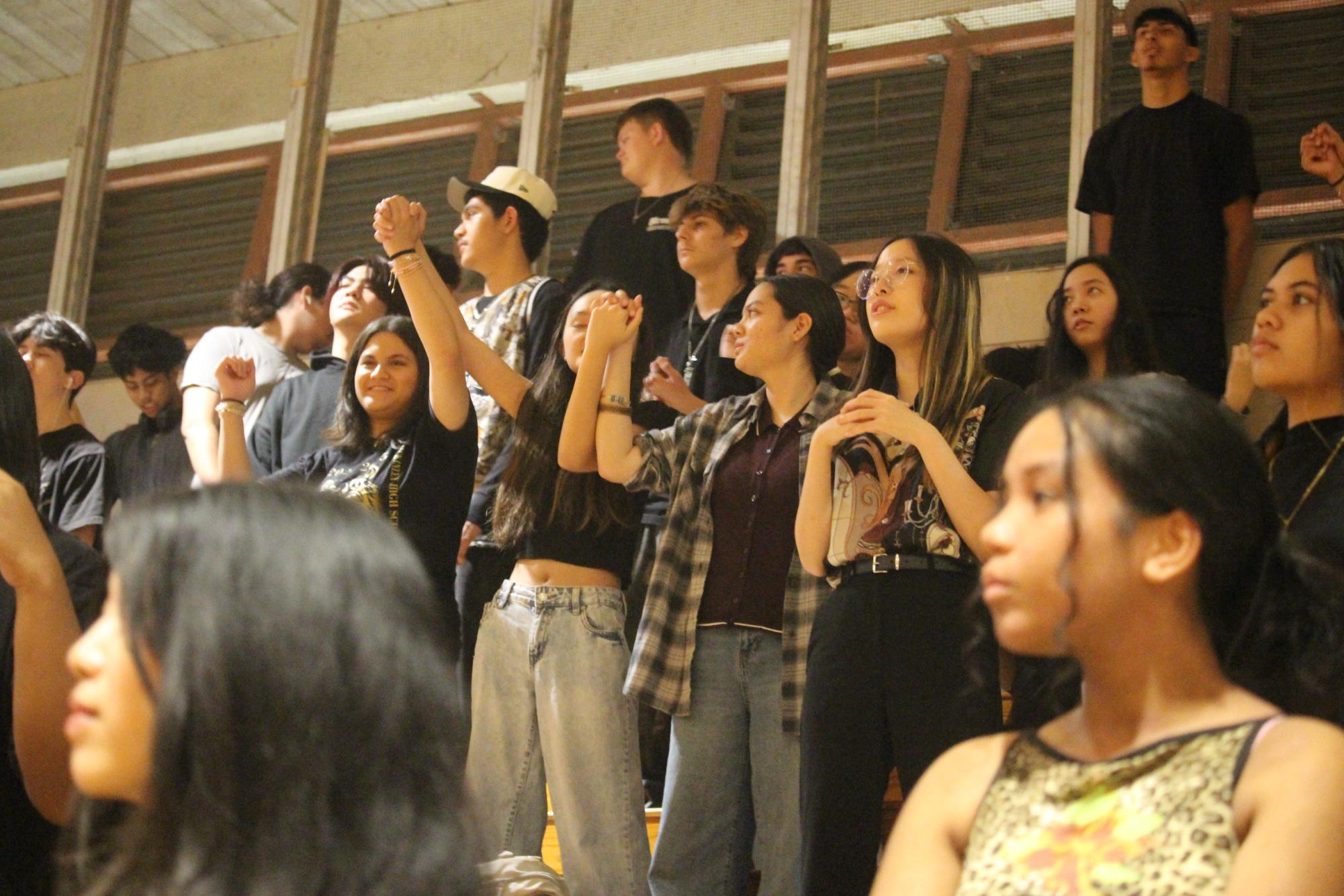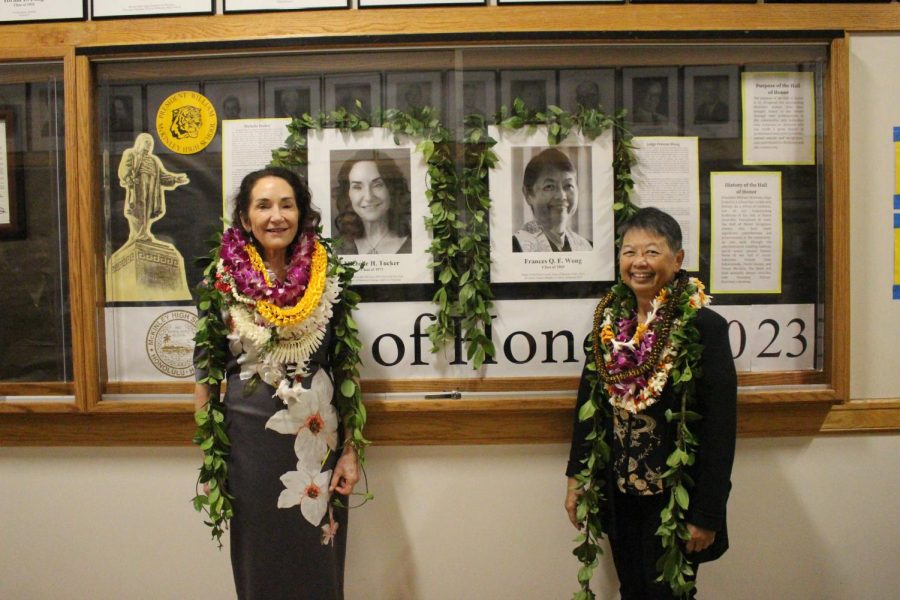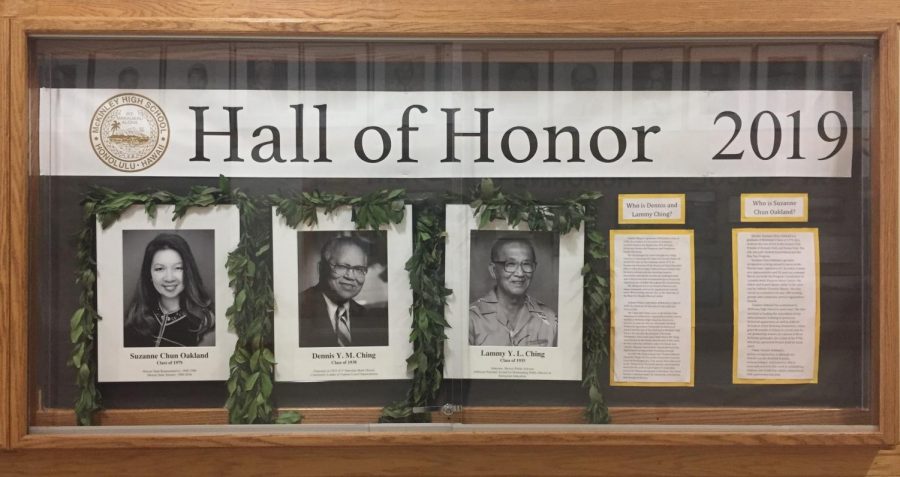
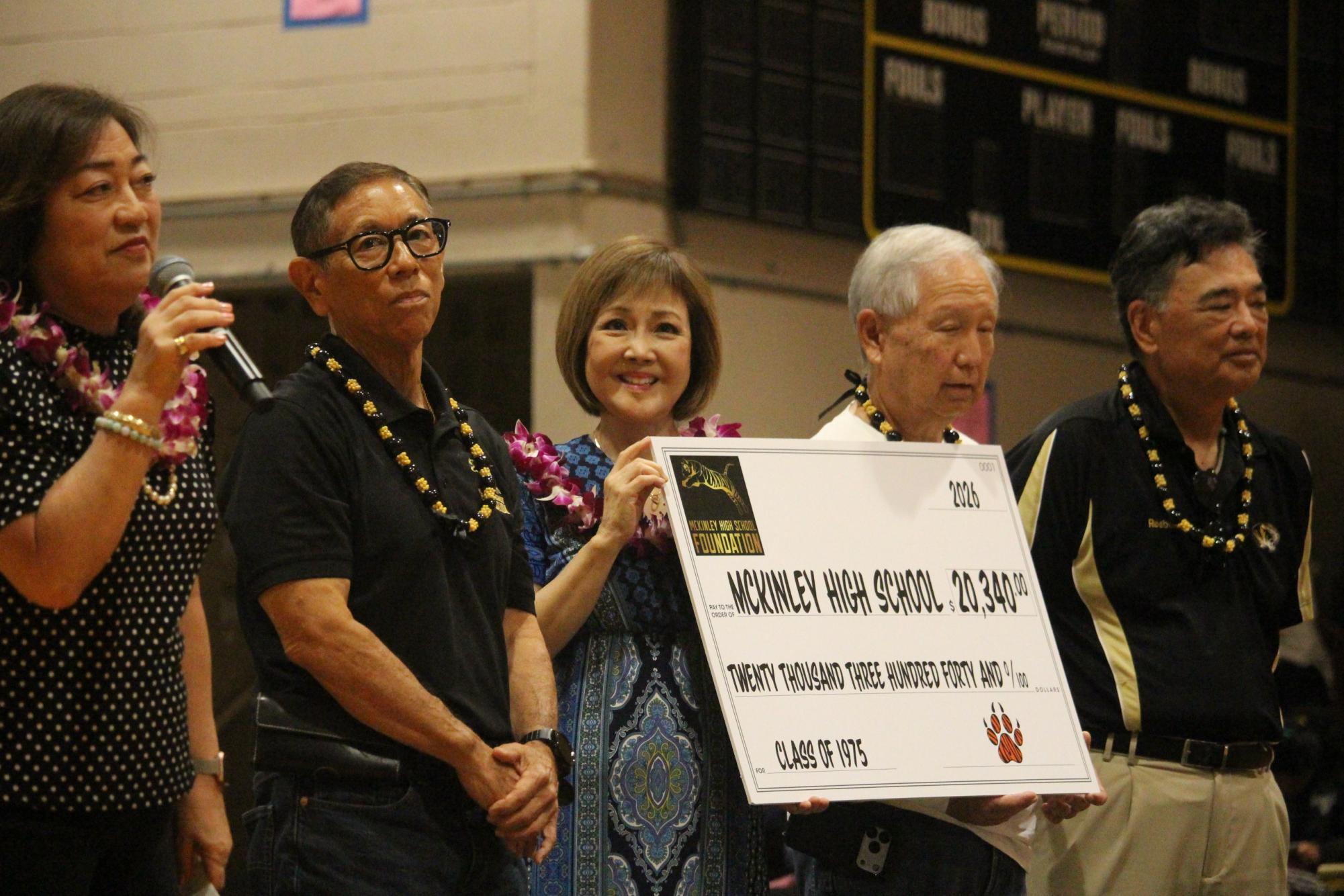
Every past year, during the last week of January, McKinley High School students and staff inducted into the Hall of Honor an alum who has made a significant and positive impact on the wider community. However, for the 160th anniversary of McKinley, there was no new inductee. Instead, McKinley’s living legacy—the students and faculty who carry the characteristics of a future Hall of Honor inductee—were celebrated.
Rajani Dhakhwa Morita, Class of 2000, teaches U.S. History and AP Psychology, and was one of the speakers during the assembly. Dhakhwa said the pride and tradition of this school is the community, and pointed to everyone in the assembly.
“Community teaches us so many things, like life skills as well as the appreciation to be able to work and live with all kinds [of] people,” Dhakhwa said. “Not every school has this. And now more than
ever, we need community.”
Although McKinley should practice the traditions it has, Dhakhwa said not to practice dogma, which is to blindly follow and do things the way they have always been done.
“Make new traditions. Make better traditions. Make your own traditions, [that can] be something we can all be proud of,” she said.
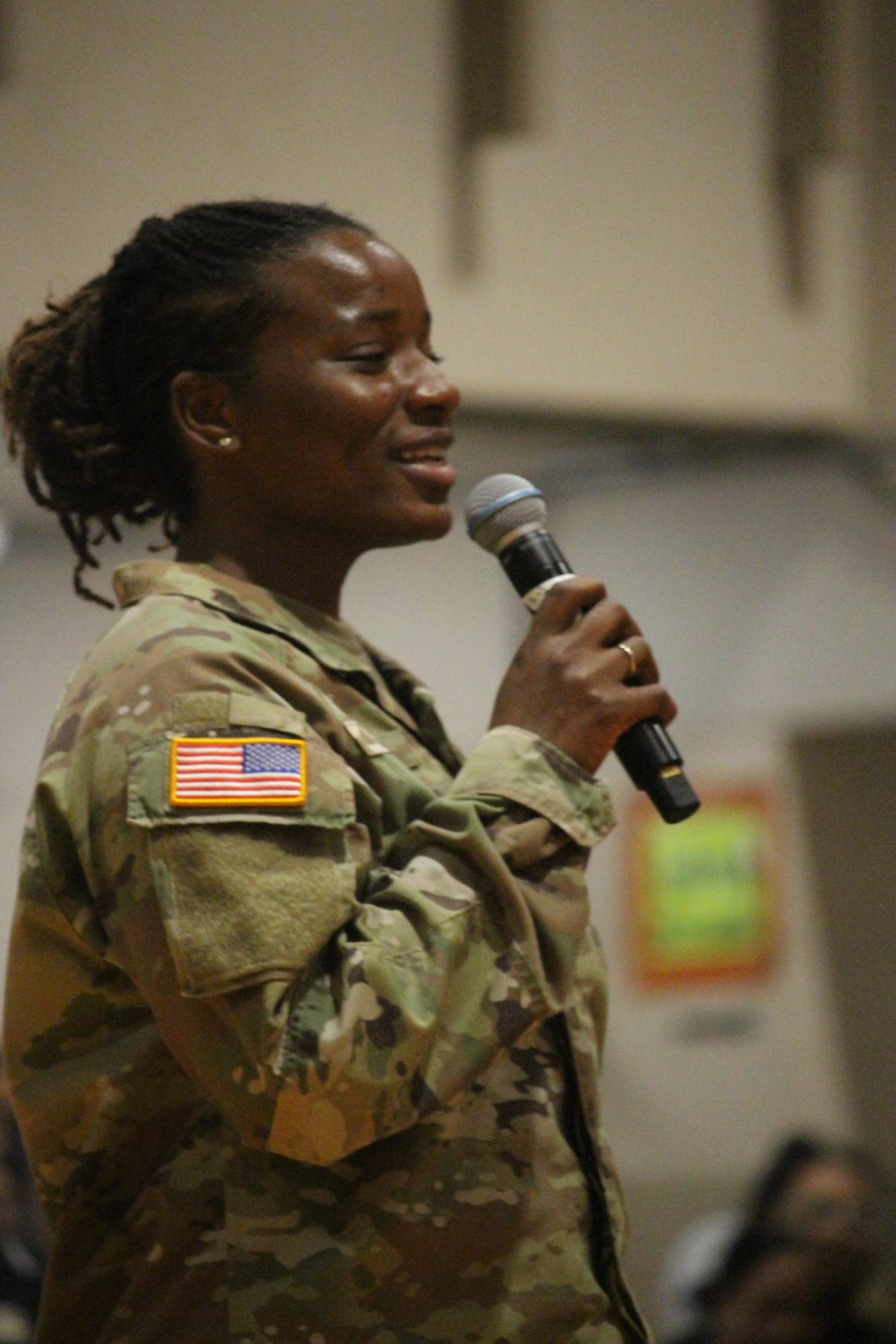
Chief Charletta Burke, the Tiger Battalion instructor, talked about JROTC and how it has been at McKinley since 1921. Burke said the Army ROTC Tiger Battalion continues to shape leaders and teach what it means to represent something bigger than themselves. She said this legacy is reflected in two McKinley Medal of Honor recipients, Daniel K. Inouye and LeRoy A. Mendonca, who both demonstrated courage and sacrifice, as well as represent- ing the values of the United States Army – setting the bar of what “right” looks like.
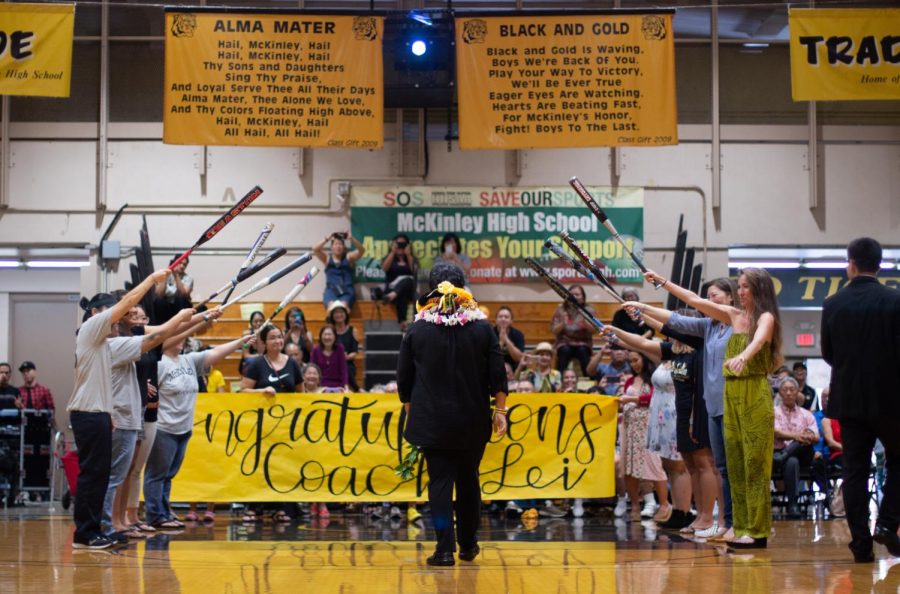
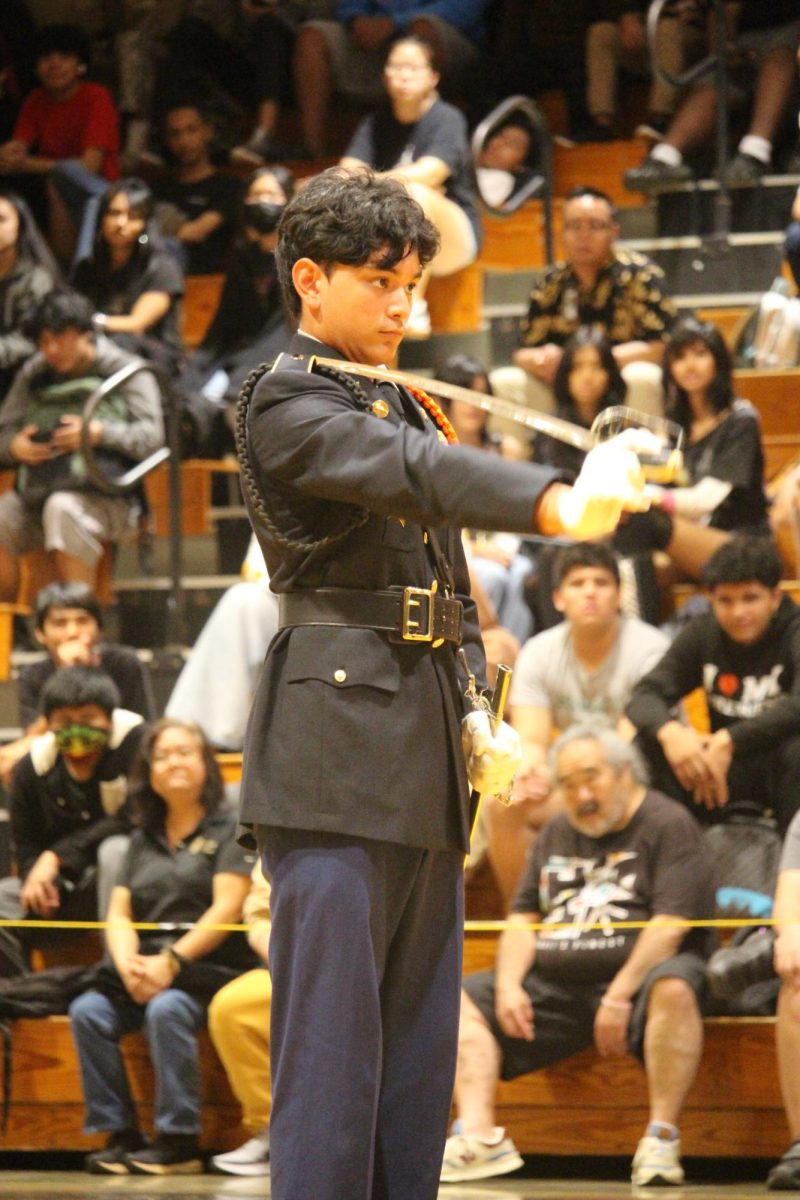
Burke then introduced the Saber team, rooted in the army cavalry tradition. The saber represents honor, precision, discipline and leadership.
“It is not just ceremonial. It is the reminder that how you move, how you lead, and how you carry yourself matters,” Burke said.
In the early years of the JROTC program, female students were not allowed to enroll, or have female teachers instruct the program. Despite this, young women found ways to be a part of the mission through auxiliary ROTC sponsor groups, which [provided support, guidance and mentorship to cadets]. Burke said the first sponsor a McKinley was introduced in April 1923, and is documented in The Pinion today.
“I am proud to stand before you as the first female JROTC instructor at McKinley High School. This is proof of progress, and that leadership has no limits.”
Burke stood in proxy of Lieutenant Colonel Manuel Puldio, who is a McKinley alumnus of the Class of 1990. Burke read a message from him, reminding cadets and the Tiger Battalion that it is not just about tiger pride, or being better than someone else. Rather, it is about being better than yesterday and taking care of one another.
“It is that quiet confidence that comes from discipline, hard work and knowing that you’re part of something bigger than yourself,” Pulido said in the message.
Burke said Pulido teaches the traditions that are connected through every generation of tigers, and the standard we uphold today. Burke adds that he demonstrates pride and honor, as well as serving and leading the cadets.
“Know that you’re not just passing through McKinley. You are the next chain. You are the future. You are McKinley,” Pulido said. “I serve and give back because I get to work alongside an incredible team. My goal is to be a spark of joy, a steady conduit of knowledge, information that can be shared without bias or agenda, to help broaden your perspectives, understanding, and opportunity for every student that is entrusted to us.”
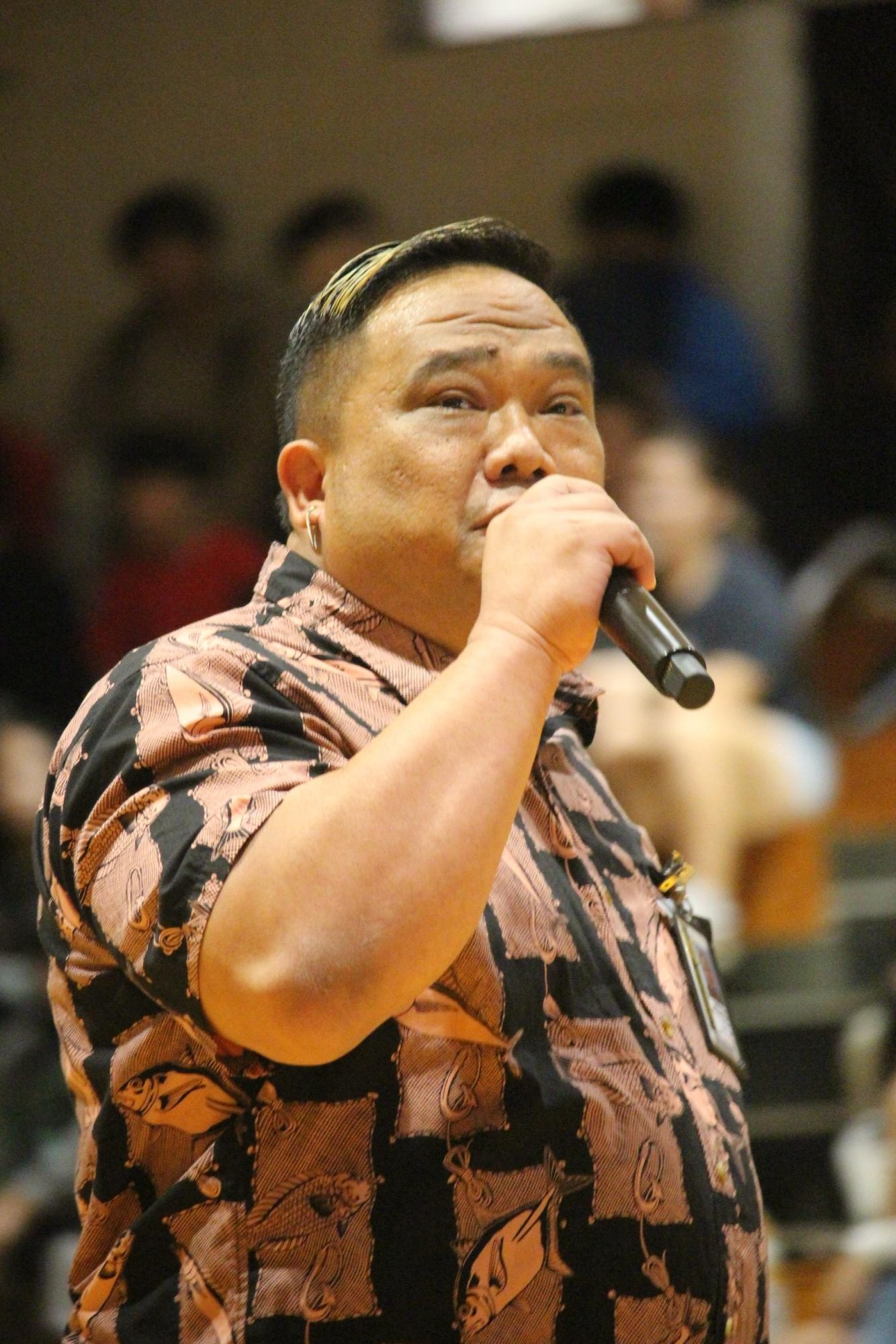
Imialoa’a Richardson, Class of 1998, teaches Modern History of Hawaii and Participation in Democracy. He said he was lucky enough to win the Oahu Interscholastic Association (OIA) championship right on the gym floor of McKinley. Additionally, his father, mother, uncle, nieces and nephews all attended McKinley.
“The tradition of singing Black and Gold every trip back home here, whether we win or lose, our team sings it because we’re ready to go to war and fight,” Richardson said. “Whenever we all sing two minutes to the end of the game, and you guys yell ‘fight’ together, that shows me that we are all fighting for McKinley.”
Richardson said to get up, fight for what you believe in and dream the biggest dream you can dream.
“For those who are doing good, keep doing good. Those of you who are not, try to do good,” Richardson said.
Joseph Nakamoto, Class of 2017, teaches Band and Orchestra. Not only was he involved in Band as a student, he was also in Basketball, Volleyball as the captain for all four years, Student Government, Center for Tomorrow’s Leader (CTL), all while taking many honor and Advanced Placement (AP) classes.
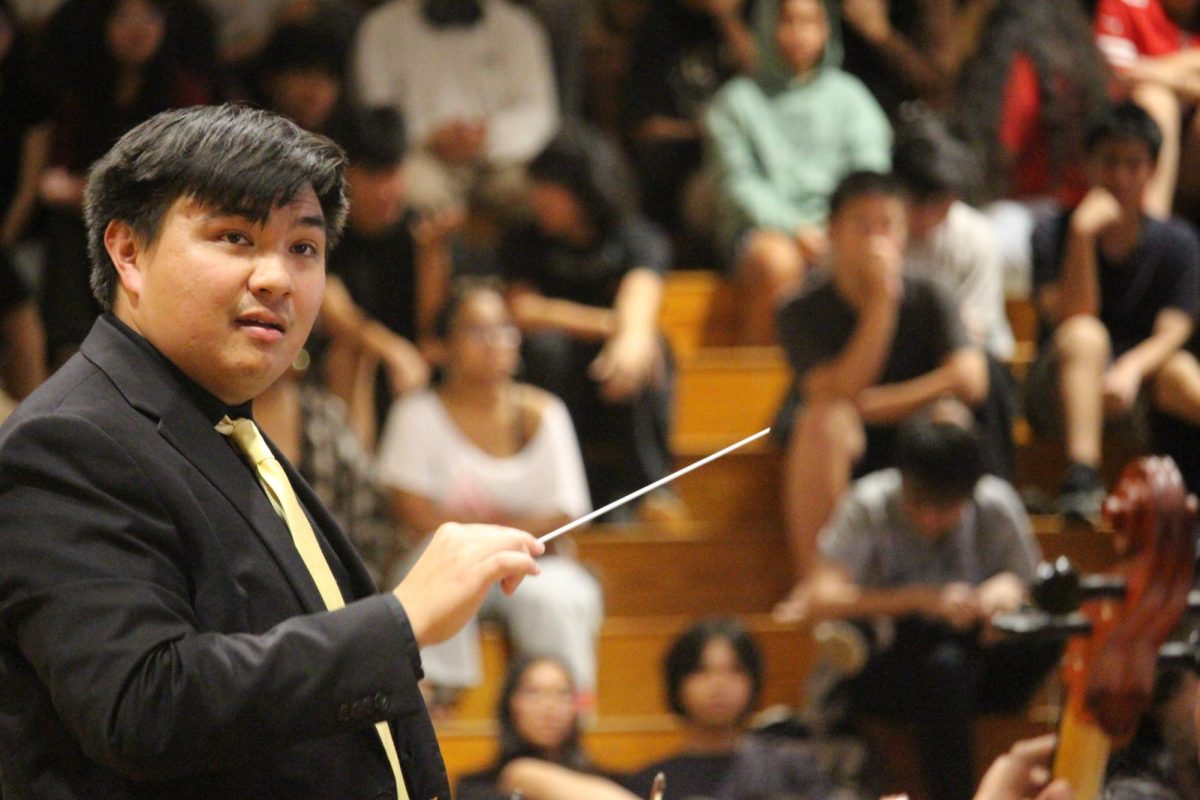
“Never settle for mediocrity,” Nakamoto said.
Nakamoto said to push for excellence and to not be complacent. He encouraged everyone to push themselves, saying that is the bare minimum.
“If you want more, you need to take care of the basics. Like showing up on time, being ready to go and listening to your teachers and friends; respecting each other. That’s the only way that we’re going to become excellent again,” Nakamoto said.
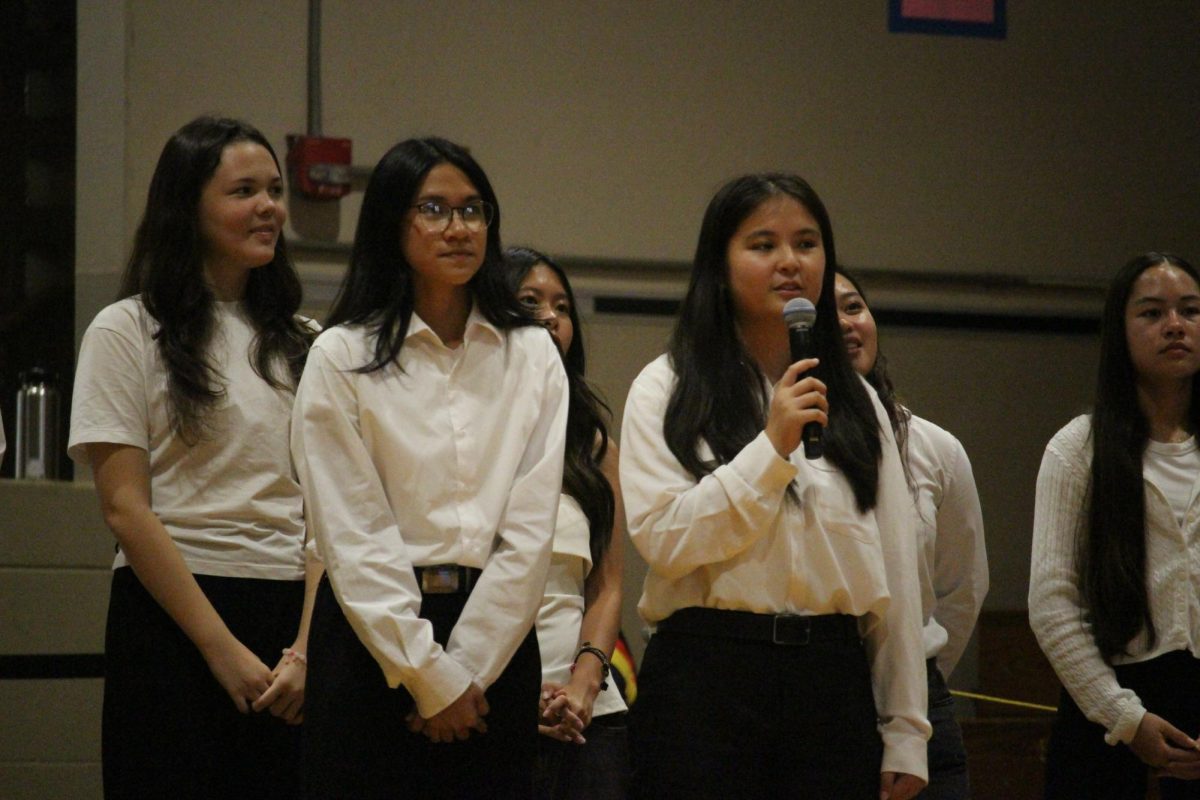
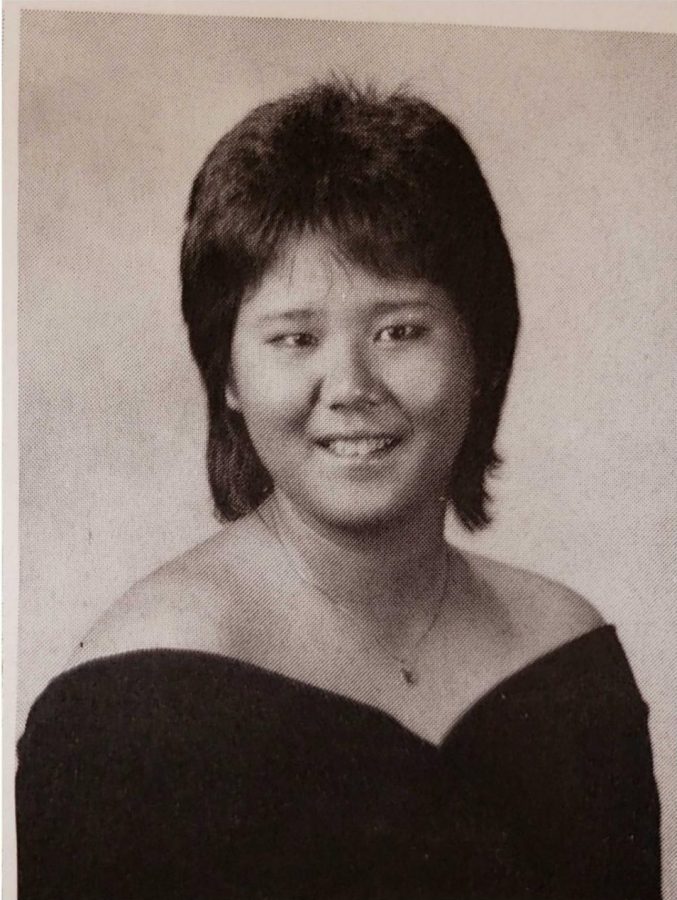
Leilani Okuda, Class of 1983, and 2020 Hall of Honor inductee, said a tradition not often spoken of is excellence. She said that when one thinks of excellence, they think of straight A’s, awards and winning every game. But there is one kind of excellence that matters more—moral excellence.
“Moral excellence is who we choose to be when no one is watching,” Okuda said. “It’s choosing honesty over shortcuts, empathy over judgment, effort over excuses, and courage over confidence.”
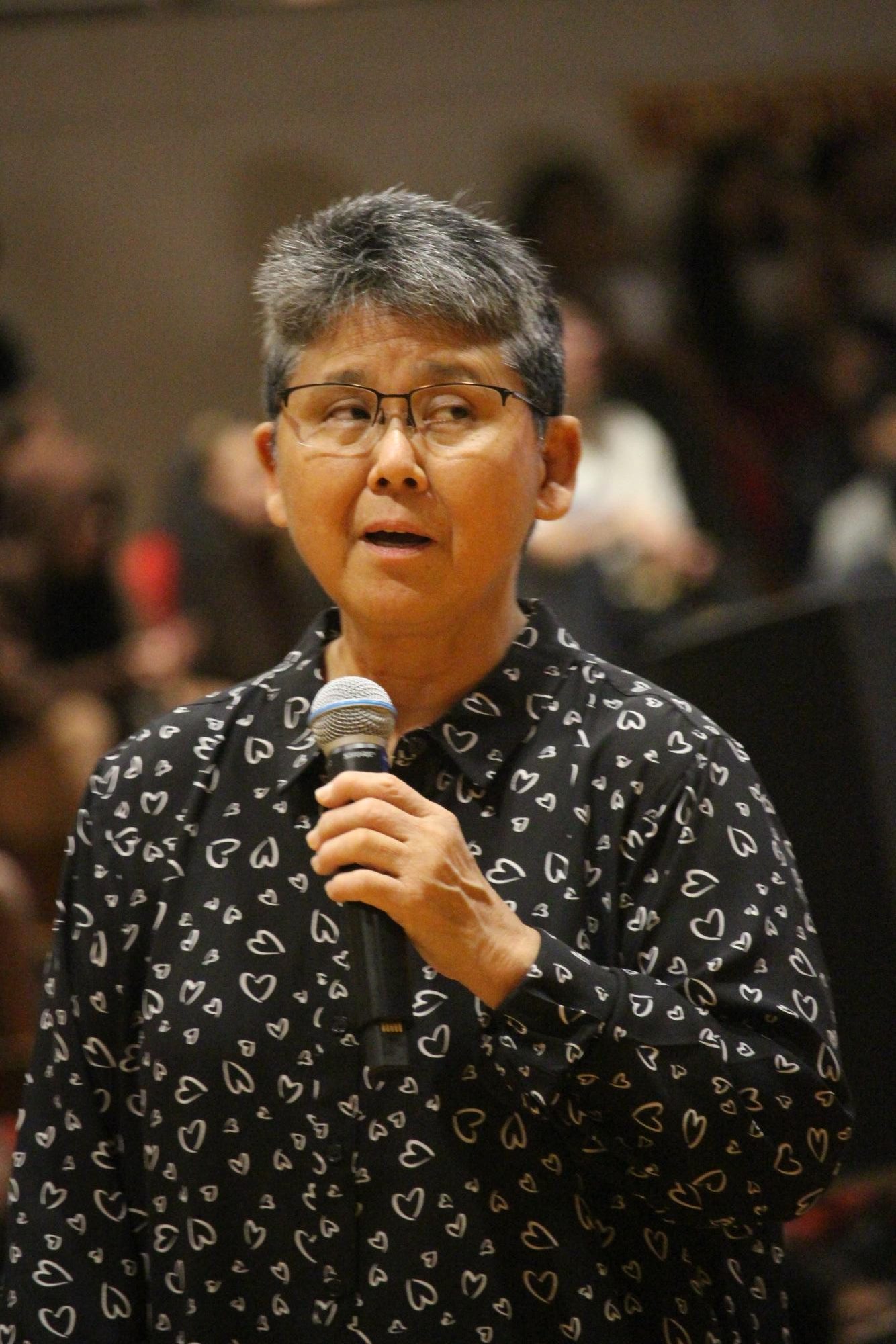
Okuda said that moral excellence shows up in small moments. It is including someone when they feel left out, owning one’s mistakes, making it right, and not making the same mistakes repeatedly. She said that it is about standing up for what is right, even when the pressure gets tough and uncomfortable.
Okuda said moral excellence shows up in small moments—Including someone when they feel left out, owning one’s mistakes, making it right and not making the same mistakes repeatedly. She said it is about standing up for what is right, even when the pressure gets tough and uncomfortable.
“These choices may not get you any applause, but it shapes our character. And believe me when I say that character is worth more and lasts longer than any award or score, as it becomes part of our fabric and it becomes part of our lives.”
Okuda said real pride is protecting McKinley’s reputation through our actions. She said the alumni represented McKinley with integrity, and it is the responsibility of the current students and faculty to continue to represent with positive characteristics.
“When you act with moral excellence, you honor those who came before you. You set a standard for those who will follow you,” she said.
Okuda said the students are not just part of the school for four years, but a part of the culture; the students will nurture it and it one day will become part of McKinley’s legacy. This is reflected as students walk across campus each day. She said it is not just about what you achieve, but also about who you are choosing to be.
Why Was There No New Inductee?
Jayden Juan (c/o ‘26), President of the Executive Council, was part of the committee that chose who to induct into the Hall of Honor. Juan said the committee goes through a very strict grading process for all inductees. They have to be suggested by a community member while also having evidence of a meaningful contribution they made to the community.
Juan said that the committee looks at those who are in the Hall of Honor and ask themselves: “Do they get to sit among the very others who have changed and impacted our islands that much?”
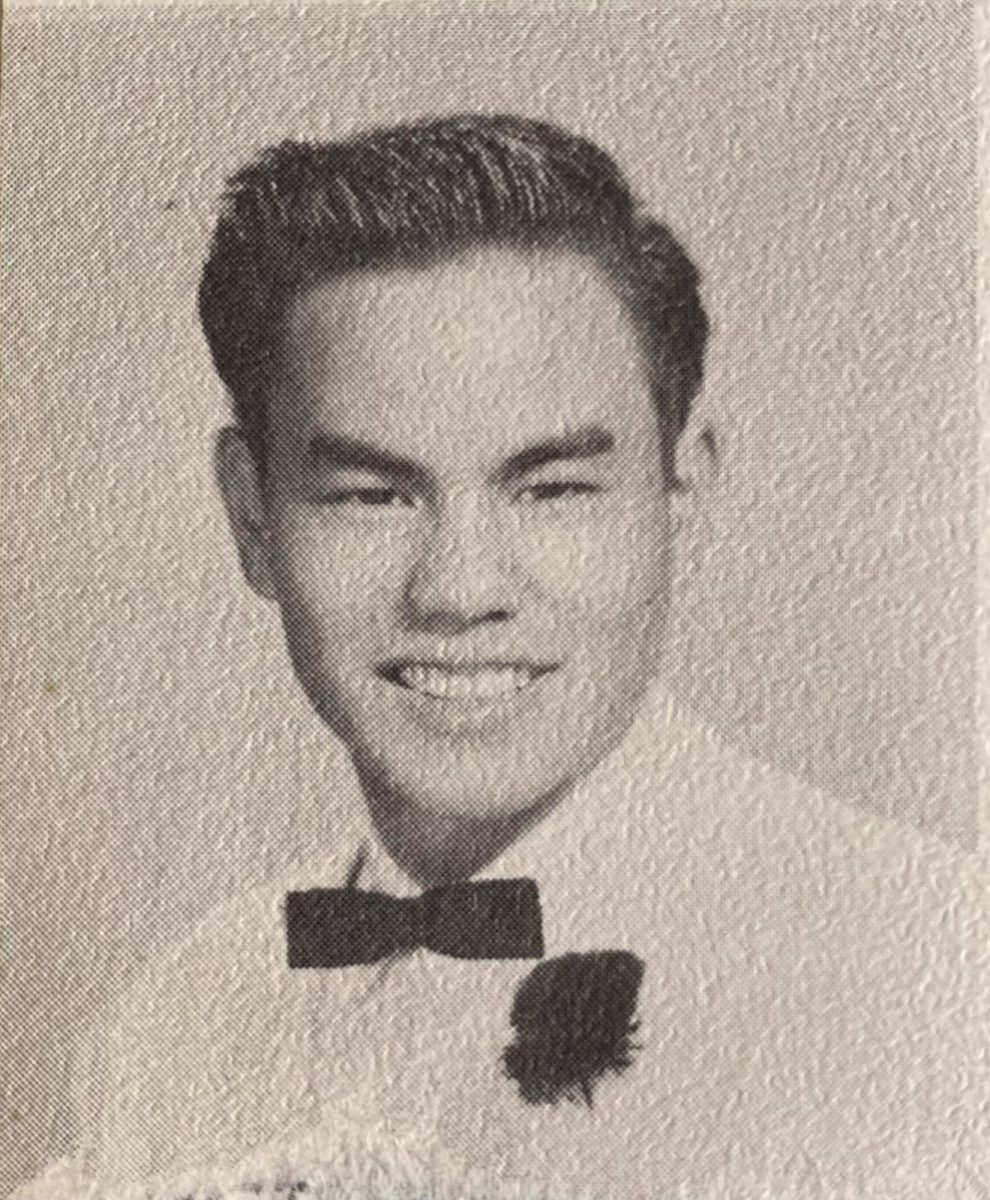
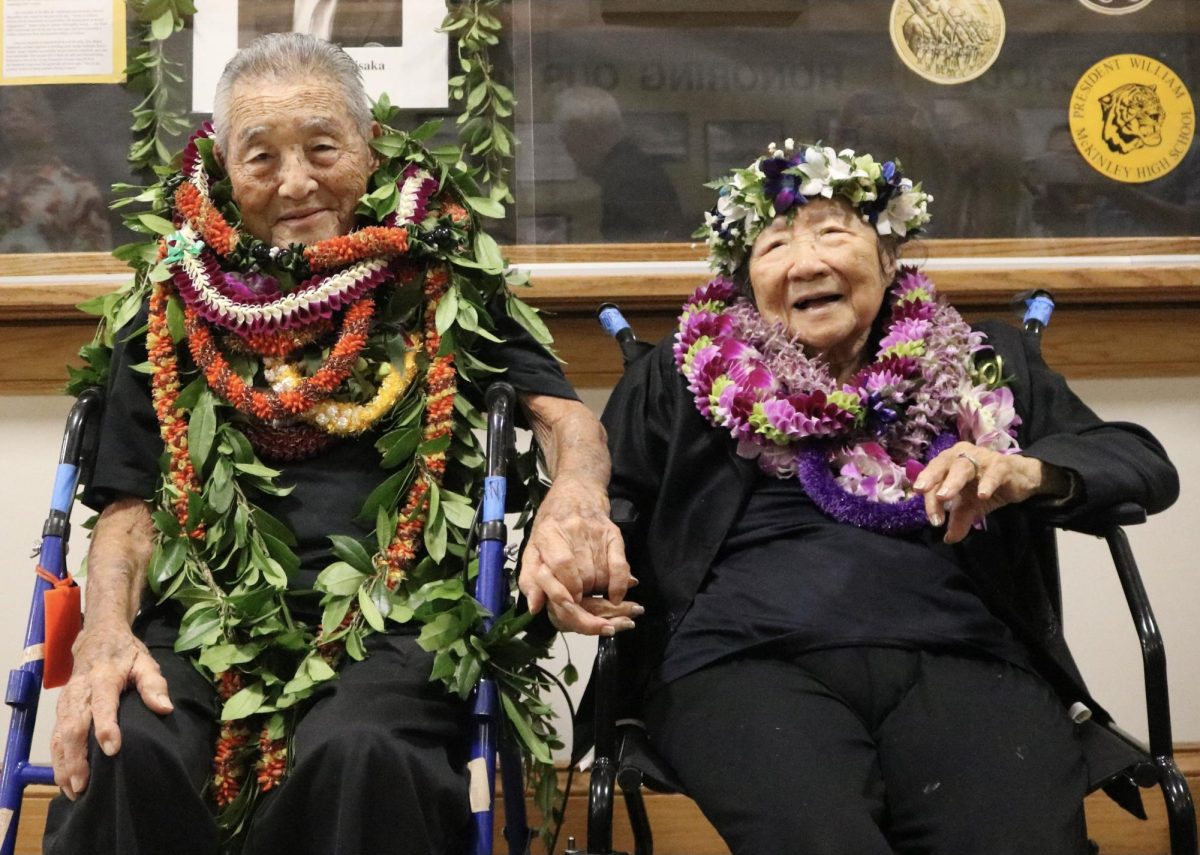
“We only had one inductee this year [who was a Nisei veteran] …we did the grading back in September,” Juan said. “He unfortunately did not get a high enough score due to his application not being specific on what he did for the community. [The application] only gave a description of the Nisei veteran.”
Juan said it was multiple iterations like this combined with a shortage of applicants and the fact that they did not pass the strict grading process which lead to the lack of an inductee for the 2026 Hall of Honor.
Dhakhwa was one of the alumni speakers for the assembly. She said when she first found out that there was no inductee, she was curious about why that was the case, since she had been involved with the process in past years.
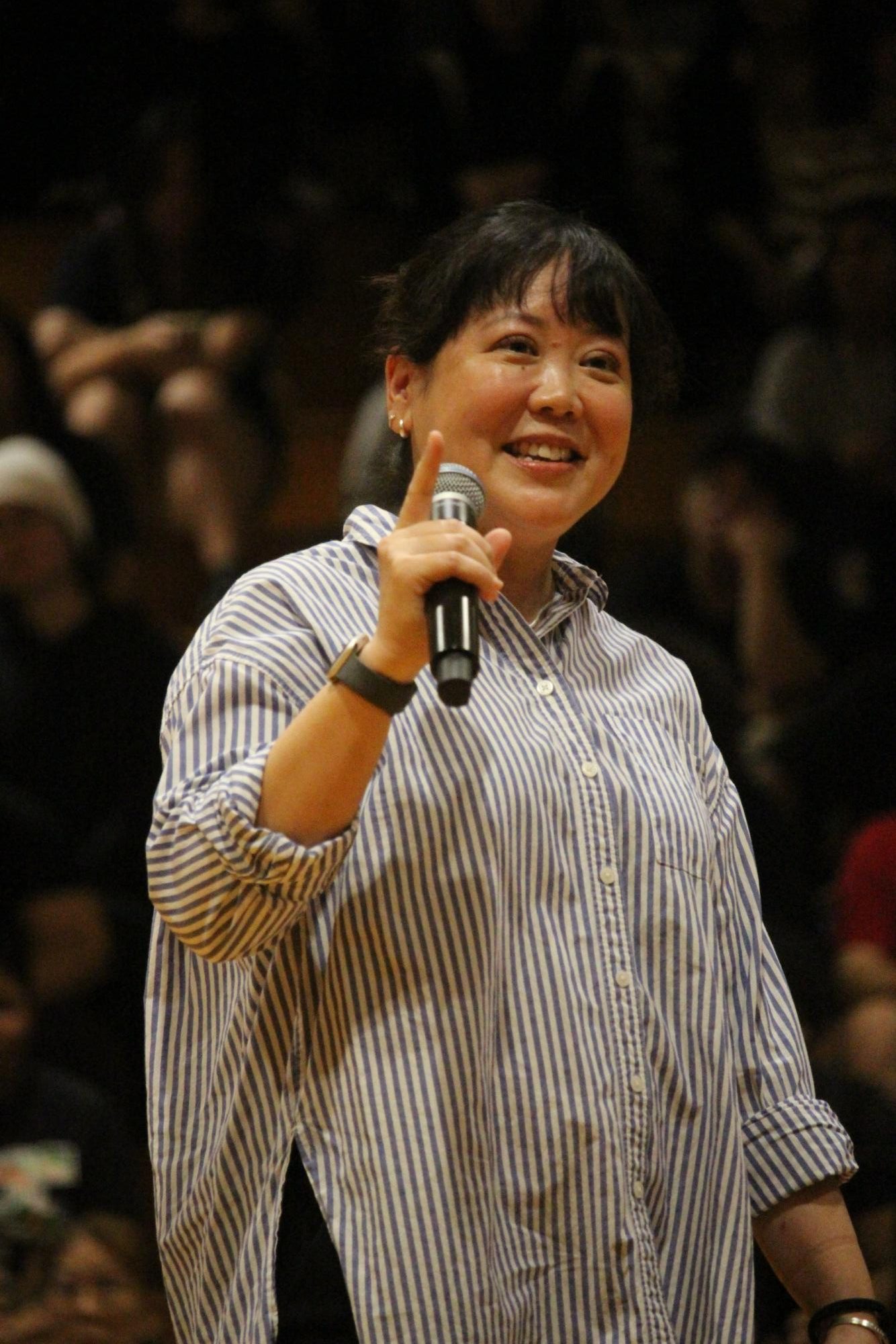
“If they didn’t find a suitable candidate, then I’m glad they’re not just letting anyone in,” she said.
Dhakhwa said she is glad McKinley is recognizing students this year. She said it shows that many students are on their way to becoming honorable members of the community. Dhakhwa was also a speaker for the assembly, being an alum of the school from the Class of 2000.
“I’m thankful that gave me a chance to get up there and address the school,” Dhakhwa said. “I was very nervous because [there were] a lot of eyes and ears [on me], but I had fun and I hope the students took something away from it.”
Jeighna Raphaela Diaz (c/o ‘26) said finding out there was no new inductee was a new feeling. She said during her years at McKinley there was always an inductee, but even then she said it did not make too much of a difference for her.
“They’re still honoring current students. I like the idea of, ‘this is our future,’ and we’re honoring them now,” Diaz said. “It was really nice to give some students recognition.”
Juan said teachers were given a Google Form where they could nominate students under different categories, such as good attitude, perseverance, selflessness, strong character, most committed and community contributor. Diaz was one of the students who was nominated for showing commitment and continuous dedication.
Diaz said she found out through an envelope during 20/20. At first she did not know it was for Hall of Honor, but once she realized that it was, she felt proud. Diaz is an avid Music Club member and officer for most of her high school career. She said she always put it on herself to do the best she can for the club, and serve the school as well if they ever need help.
“I felt happy because I did commit a lot of time to activities in school, and it felt nice to be recognized that way.”
Ezre-Moala Sunia (c/o ‘29) said she did not know the Hall of Honor honored alumni, and thought that honoring students was something McKinley always does.
“I thought the Hall of Honor goes to people who are responsible and respectful to their teachers, friends and classmates. But I did not know [it went back all the way to 1986],” Sunia said.
Juan said it was never an option to not have the assembly. He said he would like to give thanks to his Executive Vice President, Juliana Rodden (c/o ’26), for creating the idea early on in January, as the Executive Council was struggling to think of any other way to execute the assembly meaningfully besides saying, “there is no inductee.”
“I think what also helped was that this assembly was the 160th anniversary [of McKinley], which gave us lots of grounds to not only celebrate our own history, but eventually get into contact with JROTC for their 105th anniversary,” Juan said.
He worried that because the assembly was more professional and informative in nature, students might be more likely to feel bored and disengaged because the options for entertainment were more restrictive.
“Rallies are to hype up the student body and motivate them to continue forward, which is the nature of Tiger Rally. But with an assembly, it has to be formal and professional,” Juan said. “We solved this [with the] JROTC performance and the Band and Orchestra, who had played an amazing symphony for all of us,” Juan said. “That was our biggest hurdle. Finding ways to entertain our students without going out of the scope of what this assembly is supposed to be.”
Sunia said she enjoyed the JROTC armed exhibition drill team duet performance. She said that even though they messed up some parts, she is glad they did not stop and continued the performance.
“Everyone around me was hyping them up, and I could tell that a lot of them were underclassmen, so it was sweet to see people be supportive,” Diaz said.
Dhakhwa said she hopes the school chooses to recognize students every year as a new tradition, regardless of whether there is a new inductee or not. Diaz agreed with this idea, asking, “why doesn’t McKinley do both?” She also agreed with the idea of one student from each grade being recognized.
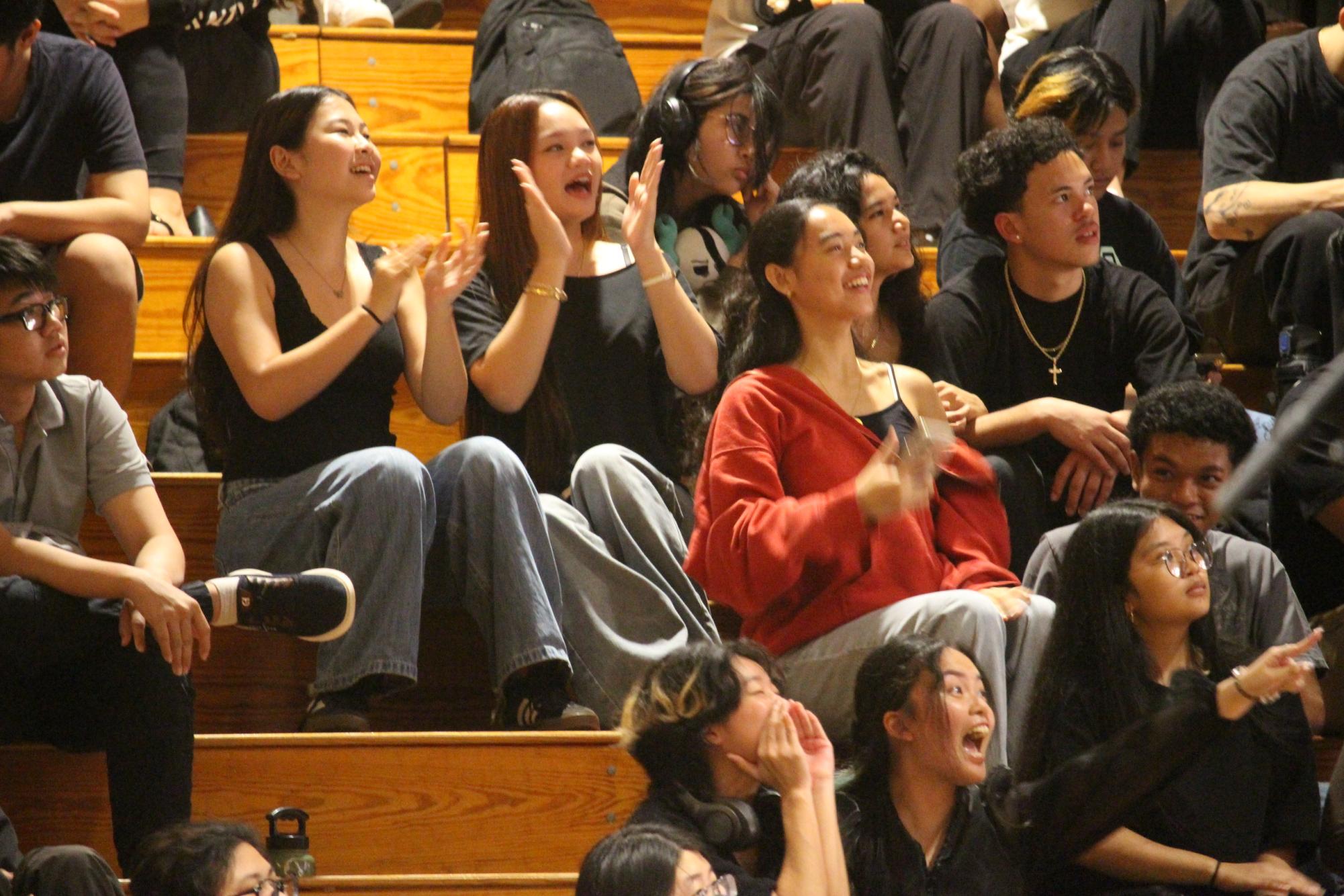
“This way, students can see themselves and be recognized for what they’re doing now, and continue to represent McKinley and our community with honor as they get old,” Dhakhwa said. “I believe if [students] want to do [their] best, [they] should step out of [their] comfort zone … Prove to yourself that you can be someone in the Hall of Honor,” Suina said.
Juan said even though there were some mistakes, he is not going to let that take away from all the wins that McKinley had this year. Juan said all around, it was an amazing assembly that really tied in the idea of McKinley’s pride and tradition. The speeches from alumni teachers, the students being nominated; and the JROTC, Tiger Battalion, and Band and Orchestra performances all contributed to that sense of excellence.