

Scrolling on your phone? Why not try scrolling through a book? Literal, a new reading app added to Clever at the beginning of this school year, allows readers to read books in the form of text messages. The reader can either scroll through the messages manually or set a reading speed so the texts roll in automatically.
This app has a vast library of books and different AI-powered features to enhance a reader’s experience. Literal can simplify specific sentences to a grade level of the reader’s choosing to help with their understanding on top of having the ability to translate books into over 50 different languages.
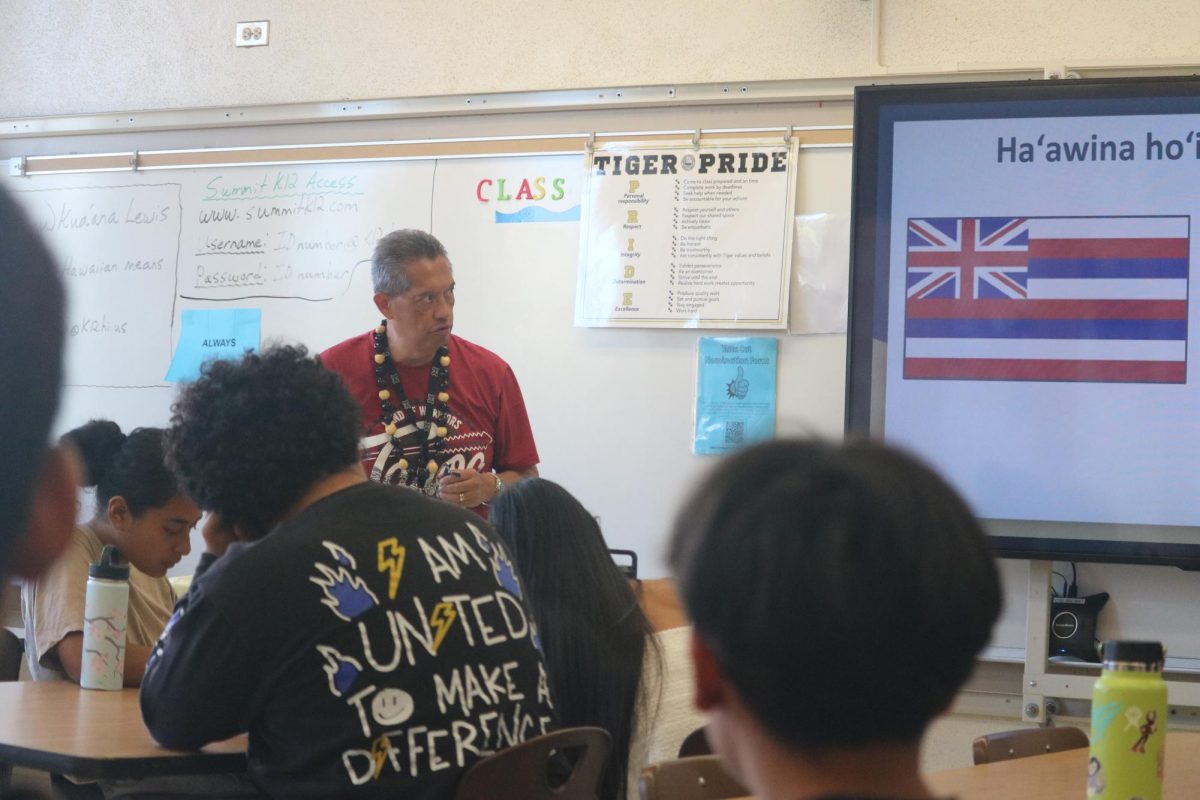
Ky Wong, Japanese teacher and swim coach, said, “It’s a good resource, but it’s kind of like a calculator. If you don’t need it, I don’t really think you need to use it.”
Wong introduced Literal to his Japanese Level 2 class at the beginning of the year as an additional resource for students to practice reading Japanese by using the translation feature. He admitted there is a high level of Japanese used in the books from the translation, the majority being Kanji, but nonetheless it is a good source for students to get exposure to the language.
Wong said he finds the line simplification tool readers can refer to while reading helpful.
“I love that because teachers can’t always simplify [things] in the way you understand it, and even if Literal is not the best way of simplifying it, it tries to do that,” he said.
When talking about using AI sources in general for learning, Wong said he believes learning from multiple voices and explanations can be helpful as long as they do not contradict each other.
English teacher Evon Le said teachers were introduced to Literal during an informational meeting at the beginning of the school year, though she has not yet mentioned the app to her students. Le said she may introduce Literal to her class in the fourth quarter as her class reads “Hamlet,” because she knows the app includes a comic version of the play which could help some students with comprehension as Shakespeare’s language can be challenging.
However, many teachers say the app’s success varies by student: stronger readers benefit more.
“I think it’s a good program for students if they already enjoy reading on their phones … but I’m not sure if it’s a good program for students that don’t like to read or aren’t really comfortable with reading,” Le said.
Le also expressed concern about how Literal’s extensive digital library is managed in a classroom setting. The app offers students access to hundreds of books in a variety of genres including mystery, thriller, young adult fiction, fantasy and historical fiction, among countless others.
“I think that [Literal] does still need some tinkering in terms of making sure that it is school appropriate because right now it’s more like a very open library and the teachers don’t really have control,” she said.
There are also concerns among teachers about the app marketing itself as “Reading for the AI generation” or even “the TikTok generation.” Multiple teachers said they believe labels are never good for students and don’t support Literal advertising themself for those specific generations.
Erin Britos, another English teacher, said, “I wouldn’t want to be a part of any AI generation myself. I think students might not appreciate that label either.”
Most students The Pinion spoke with about this app were hearing about it for the first time and their first thought was the app sounds “interesting.” One student even said the program layout is “weird,” after they saw the app and the way it’s made to look like text messages. Many agreed it is a good reading outlet if one already enjoys reading on online platforms or if one is interested in trying out a new form of reading.
Kaia Matsuoka (c/o ‘28) has not used the app before, but based on what she saw of the app from a Pinion reporter, she said, “I think [Literal’s format] might work for some people and if they prefer to read like that but it’s all preference.”
Matsuoka said personally, she would rather read a physical book than online e-books. She said she can see this app being used in class but it really depends on each student. Jordyn Dong (c/o ‘28) agreed with Matsuoka and raised concerns about how the app might be perceived in the classroom, questioning whether teachers would recognize Literal as a reading app or mistake it for students texting during class.
When talking about how this app is being advertised as reading for the AI and TikTok generation, Matsuoka and Dong said it’s not necessarily wrong but it definitely is not a label that applies to everyone. Matsuoka said, “The TikTok- bound generation does not define all of us but it describes the majority of us.”
Britos said students are craving more human connection and there is something special about holding a physical book, showing her support for physical books over online programs.
Aside from any criticism about the app, Wong said he does see a future for Literal in learning and in the development of better features as well as more apps.
“Programs like Literal are really just trying to match your needs as as learners,” Wong said, “I think that every program that’s ever come out, is going to influence more programs to develop … It’s taking inspiration from what already existed and capitalizing on the best part of it and going on.”
This article has gone through the following process: pitch, interviews, drafting, peer feedback focused on content/structure, revision, peer feedback focused on language/conventions/style, self-checked for ethics and fact-checked by sources. Student editors approve the article for publication.