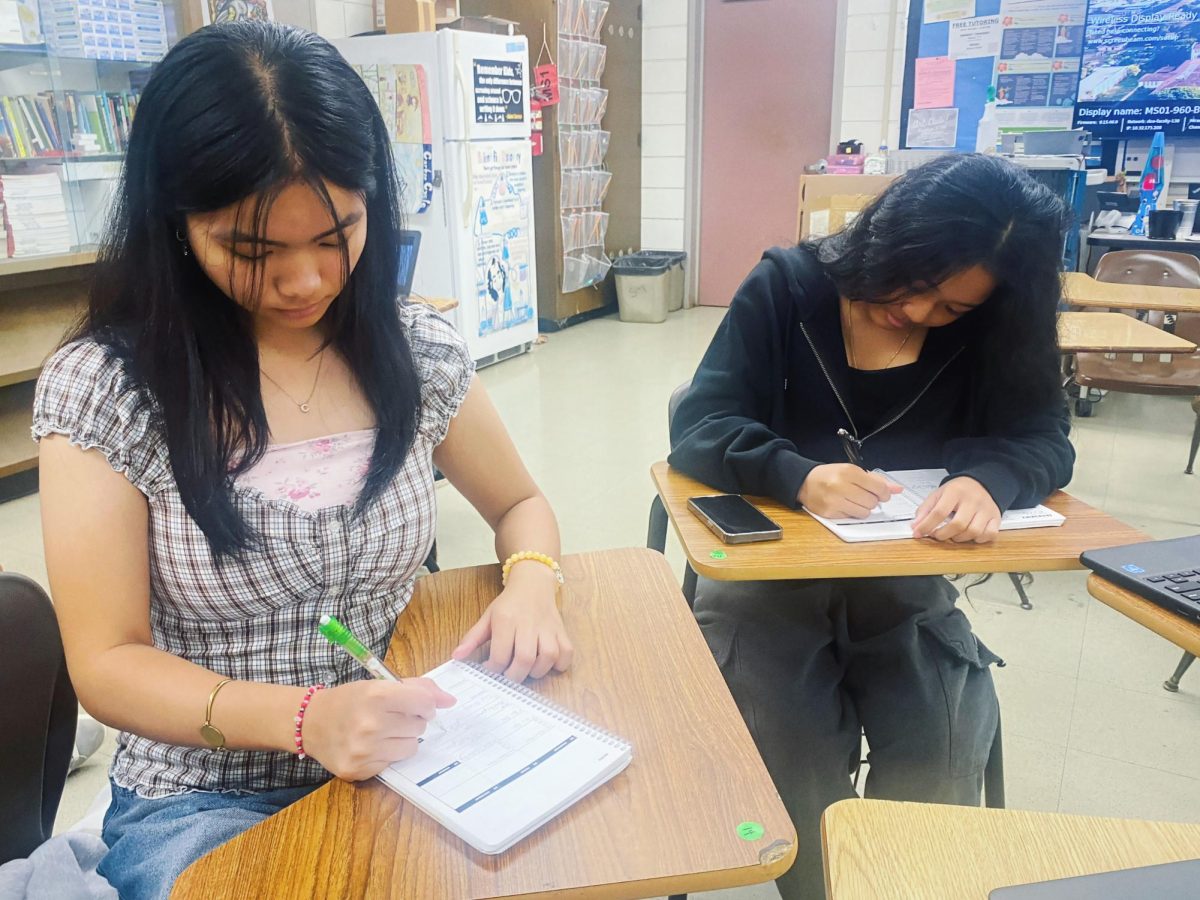
Effective this 2025-26 school year, only 9th graders at McKinley High School got school planners. In previous school years, every grade level received one from their 20/20 teachers.
Principal Ron Okamura said it costs a lot of money to customize the planners, and not a lot of students were utilizing them. Okamura said when he asked students to write things in their planner, they would say, “What planner? I don’t have a planner.”
“When you find [planners] in a rubbish can or you find it just laying around on campus, it’s a little disheartening for all of us. Here we thought this is an important piece students would want to have, and yet not,” Okamura said.
Okamura asked the teachers who actually used the planners now and found out it was mostly the 9th graders, hence, only they got planners this year. Based on his observations, Okamura said the changes will be in effect next school year too. Okamura said the idea of having planners be something students could pay for, like yearbooks, was talked about. He also said they would have to calculate how many planners they have to order if that were to happen.
“Ninth grade is a whole transition year. There’s a lot of things going on in school that they would have to take notes on,” Okamura said.
Margie Saramosing (c/o ‘29) uses a school planner every day to write down homework. She said she feels “in between” regarding the changes because some students need to use the planners while others may not. Saramosing said the planner helps her remember things as she is a forgetful person.
“It’s kind of not okay. … I feel like if [upperclassmen] don’t get planners though, they could still buy [a planner on their own],” Saramosing said.
Chloe Fabro (c/o ‘29) said she somewhat disagrees with the change, because she believes some upperclassmen did use the planners. Fabro said.
Amy Liu (c/o ‘27), who was given a planner by the school during her freshman and sophomore years, thinks the faculty should have asked students for their opinion before ordering planners.
“Some people were like, ‘I actually do like the planner. I like how we can see odd or even days or when we don’t have school,’” Liu said.
When referring back to her experience with the planners, Liu said she liked writing down her top assignments in the “do now” or “what you should do for the week” section.
“Really, it was just to have it down on paper so I could remember it better. And if I don’t remember, I have something to look at instead of digging in my head,” Liu said.
Liu also has a separate planner at home where she writes things she needs to do. Now that upperclassmen are no longer given school planners, she only uses her home planner to stay organized.
Sylvia Lee (c/o ‘27) said the planners helped her transition into high school by letting her know what was due so she did not have to constantly check Google Classroom. She thinks it would be great if all grade levels were given planners, as it could be helpful to them.
“I feel like there are a lot [of people] that don’t really care about staying organized,” Lee said.
Nowadays, Lee mainly relies on her memory, occasionally writing things down and using the notes app on her phone to stay organized.
“I would try and think about what periods I have the next day and recall, ‘Do I have something for this? Something for that?’”
Megan Serrao, a 9th-grade English teacher said the discussion has been about whether or not planners were worth the monetary investment. She believes teachers were not adequately consulted during the decision-making process. Serrao said she is a big proponent of requiring students to use planners, and she said teachers should teach students how to think ahead, break down assignments, know when things are due and be accountable.
“There’s so much happening in our lives that we could be focused on something in class, and then as soon as we leave, we forget about it. But if you write it down, it’ll help,” Serrao said.
For the whole first school semester, Serrao said she had students pull out their planners at the start of class and write down assignments. Now in the second semester, Serrao said students do this on their own, as part of a routine.
“Some of our students are very organized naturally, and so they like it. Other people like to put things in digitally. Some people are not organized, and you need to hold their hand, so they don’t really love it and they say they’re not even gonna check it anyways,” Serrao said.
Despite mixed reactions, Serrao believes planners are helpful. Teachers only know what happens in their class, but with planners, they know what students in their 20/20 have to accomplish. Serrao has also found planners to be helpful as a source of parent-teacher communication.
“When I’m talking to parents and asking them to check planners, maybe they’re not able to check Infinite Campus as much, so it’s just another way of doing that,” Serrao said.
Serrao said she thinks some students will purchase planners on their own when the time comes. Previous students have asked her why they were not given a planner this year, and proceeded to show her the planners they bought on their own.
“The ones that have come to me said that they would rather have the school planner because the way it’s set up, it says 20/20, the classes and study hall, so it’s more tailored to what they need for this school,” Serrao said.
Based on her observations, Serrao believes this change will still be in effect next school year, as there is a debate on whether planners are worth the monetary investment.
“Some teachers and people on campus say it’s a waste of time and money because students aren’t using them.” Serrao said.
“And then you have people on the other side that say, we cannot expect students to be organized if we don’t give them the tools that they need.”
Zoe Smith, a 9th grade science teacher, said it would not surprise her if the changes remain or change again next school year. Smith said she is not sure if the planners are necessary for all students moving forward because a lot of students do not use them. However, she said it is incredibly helpful for others that do.
“[Planners were] an additional thing that wasn’t being used. But I think it’s good to at least get some of the kids in the habit … so if they find that it’s useful, in the future, they can continue it on their own,” Smith said.
Rajani Dhakhwa Morita, who teaches 10th grade US History and AP Psychology said she printed out generic planner templates at the start of the second semester for students after noticing some of them were turning things in late or forgetting assignments. Dhakhwa said she knows not everyone will use planners, but she believes students need the opportunity to try in order to be in the habit of using it. She also said students might appreciate planners more if they had the option to choose whether they want it.
“I hope the school is able to and be willing to offer student planners as an option. I know they can be expensive and it takes work for it to come into fruition … but it can be helpful for students because it’s obvious our phones are not the perfect solution to keeping track of all of our daily obligations,” Dhakhwa said.
Dhakhwa also said students might feel less overwhelmed and anxious if they kept track of their tasks.
“Planners can also give us a dopamine boost and a sense of satisfaction,” Dhakhwa said.
This article has gone through the following process: pitch, interviews, drafting, peer feedback focused on content/structure, revision, peer feedback focused on language/conventions/style, self-checked for ethics and fact-checked by sources. Student editors approve the article for publication.